
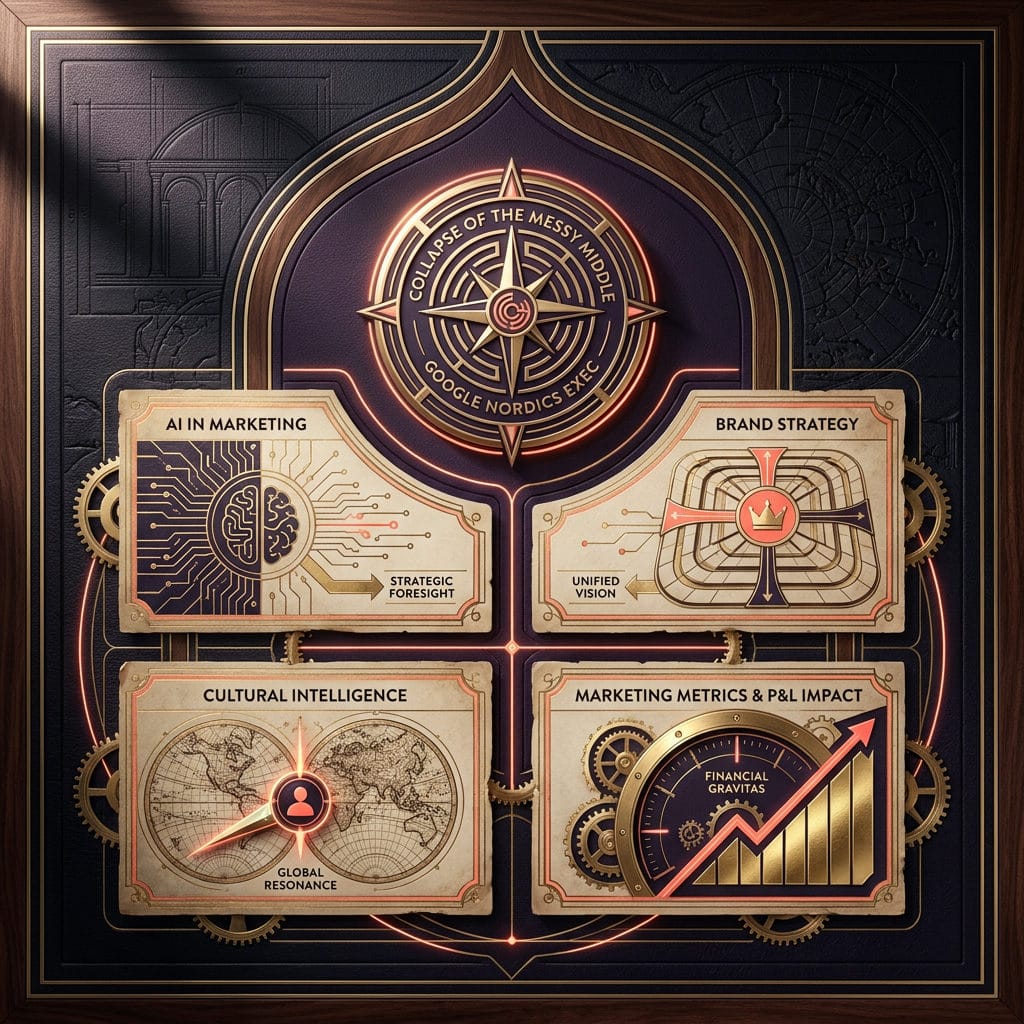
The strategic marketer’s new mandate is to master the 'messy middle'—navigating the invisible currents of AI and culture to build enduring brand authority and drive P&L impact.
📊 9 episodes across 7 podcasts
⏱ 319 minutes of intelligence analyzed
🎙 Featuring: Alex Brownsell (Head of Content, WARC), Dr. Karen Nelson-Field (Founder & CEO, Amplified), Carl Wåreus (Head of Partners & Specialists, Google Nordics), Scott Reijinders (COO, Connect - part of The Up&Up Group)
|
One Big Thing
The convergence of AI, attention scarcity, and cultural complexity is forcing a fundamental re-evaluation of brand strategy. Legacy metrics like impressions are giving way to memory and brand authority in an AI-driven landscape, creating an urgent need for marketers to understand how their brands are perceived by both human and artificial intelligence.
The Challenge: Brands face a "visibility starvation" issue in low-attention media, compounded by AI’s ability to navigate the traditionally human-managed "messy middle" of consumer consideration. This shift means that traditional marketing funnels are collapsing, with awareness, consideration, and conversion happening almost simultaneously within a single content piece, as highlighted by Emmanuel Cruz, Assistant Vice President of Digital Marketing at Philippine Airlines, who noted, "You get consideration and awareness and conversion all in one set of an ad or set of content."
The AI-Culture Nexus: The "silent zone" of media, invisible to AI training, and the "vocal zone" of high-attention environments that generate human engagement, directly influence a brand's authority in the eyes of AI. This is not just a technological challenge; it’s a cultural one. Rachel Lowenstein, Cultural Strategist and Content Creator, defined cultural intelligence as "the distinct skill as being able to identify what is happening in culture beyond individual inflating trends and being able to apply that to what it means for brands and businesses." Brands that fail to integrate cultural intelligence into their strategies risk reputational damage, as Allison Knapp Womack, CEO of Effie LIONS Foundation, warned, "If you got it wrong before, you got a bad ad...but now it's a reputational digital viral disaster that can affect your business for the longer term."
Why it matters: Marketers must rethink their approach to media, creative, and talent. Ensuring brand visibility requires understanding how Attention AI for media planning & creative production works, and leveraging automated creative at scale via tools like the Hummingbird engine, as Scott Reijinders, COO of Connect - part of The Up&Up Group, discussed on The WARC Podcast. Moreover, fostering cultural intelligence within marketing teams by valuing diverse perspectives and "new hard skills" like personal networking, as Rica Facundo from The WARC Podcast pointed out, is critical for future relevance.
"We're seeing a fundamental shift in our people search and moving from blue links to more into conversations. And then for for marketer this is becoming then like a collapse of the messy middle."
— Carl Wåreus, Head of Partners & Specialists at Google Nordics on The WARC Podcast
The Opportunity: This shift is not just a threat but an immense opportunity for brands with strong equity built on authentic cultural resonance and superior attention capture. Those who master the nuanced interplay between AI-driven visibility and human cultural understanding will gain a decisive competitive advantage, turning the "messy middle" into a strategic differentiator.
The Rundown
① Marketing is a sales multiplier, not just a lead generator.
Ellina Shinnick, CMO of HUB International, shared how embedding a marketer directly into regional sales leadership meetings led to faster campaign activation and a 3x improvement in lead conversion, fundamentally changing the relationship between the two functions. (Ellina Shinnick on Renegade Marketers Unite)
→ Strategic Insight: CMOs must actively cultivate trust and shared accountability with sales teams, moving beyond lead handoff to joint pipeline and revenue ownership, including leveraging tools like Gong for call analysis to refine messaging.
② Audio is a powerful, undervalued asset for building memory and brand effects.
System1's 'Double Double' audio research reveals that including just 11% audio in a media mix can double large business effects for campaigns, with audio being 20% more likely to be recalled than visuals in TV ads, indicating its deeper neurological connection to memory. (Andrew Tindall on That's What I Call Marketing)
→ The Implication for CMOs: Marketers should strategically integrate audio into their media planning, recognizing its cost-effectiveness in building distinctive memories and reducing price sensitivity, rather than solely focusing on visual creative.
③ Cultural intelligence is the new risk mitigation for brand strategy.
The potential for cultural missteps has intensified, moving from "bad ad" to "reputational digital viral disaster," making the ability to identify higher-order cultural shifts a critical skill for brands to avoid significant business impact. (Rachel Lowenstein on The WARC Podcast)
→ Strategic Imperative: Building diverse and culturally intelligent marketing teams, and actively listening to youth insights, is no longer a "nice-to-have" but a core competency for modern brands to resonate with evolving audiences and mitigate reputational risks.
④ B2B marketing operates on "hard mode" and demands long-term ecosystem building over short-term campaigns.
Ty Heath, Former Leader at LinkedIn B2B Institute, underscored that B2B marketing requires navigating multiple stakeholders and longer sales cycles, making repeatable, foundation-built strategies and a focus on generating buyer confidence more crucial than chasing fleeting trends. (Ty Heath on Sleeping Barber - A Marketing Podcast)
→ The Implication for CMOs: B2B marketing leaders need to shift from campaign-centric approaches to architects of ecosystems that drive long-term confidence and repeatable success, simplifying strategies to ensure clear, consistent messaging across complex buying committees.
Signal Board
🔥 Heating Up
• Sales-Marketing Trust and Partnership: Shared accountability for pipeline creation and revenue is driving stronger alignment and better outcomes for marketing efforts. (Joan Jenkins on Renegade Marketers Unite)
• Mission-driven brand building in tech: Brands with clear missions and products users connect with deeply are experiencing significant growth and customer loyalty. (Doug Sweeny on Marketing Vanguard)
• Youth insight into cultural trends: The marketing industry increasingly relies on younger generations' innate understanding of evolving culture, making their perspective invaluable. (Rachel Lowenstein on The WARC Podcast)
👀 On Watch
• Attention AI 🆕: Generative models are being developed to optimize creative content for visibility in an AI-driven landscape. (Dr. Karen Nelson-Field on The WARC Podcast)
• ŌURA Ring 5 🆕: Innovations in wearable tech are focusing on smaller form factors, longer battery life, and comprehensive health monitoring beyond basic tracking. (Doug Sweeny on Marketing Vanguard)
• Unforgettable Brands (Meta research) 🆕: A shift in marketing metrics from impressions to memory is gaining traction, emphasizing deeper engagement. (Andrew Tindall on Sleeping Barber - A Marketing Podcast)
🧊 Cooling Off
• Campaign-centric approaches in B2B: The focus is moving away from isolated campaigns towards building repeatable ecosystems and long-term buyer confidence. (Ty Heath on Sleeping Barber - A Marketing Podcast)
• Differentiation vs. Distinctiveness in Marketing: The long-standing debate persists, with academic research challenging the existence of true differentiation in the eyes of customers. (Andrew Tindall on That's What I Call Marketing)
• Traditional linear marketing funnels: The ability of platforms like TikTok to integrate awareness, consideration, and conversion within a single content piece is collapsing conventional funnels. (Emmanuel Cruz on The CMO Show)
The Tension
The marketing industry is grappling with a fundamental tension between optimizing for short-term sales through 'deals' versus building long-term brand equity through 'feels' and emotional creative.
🏛️ The Status Quo Doctrine: In the lead-up to critical sales periods like Q4, there's a prevailing industry tendency to prioritize "salesmanship" – direct, persuasion-based content focused on driving immediate conversions. This approach, while delivering short-term gains, often comes at the expense of sustainable brand growth. As Andrew Tindall of System1 noted on Sleeping Barber - A Marketing Podcast, this can have a "damaging impact on long-term brand growth, making future marketing efforts harder."
🚀 The Challenger Doctrine: A growing body of evidence advocates for "showmanship" – emotionally resonant, distinctive creative that builds long-term memory structures and reduces price sensitivity. Andrew Tindall, also on That's What I Call Marketing, pointed out that "emotional advertising campaigns have significantly longer effective lifespans than persuasion-based ads, making re-airing them a highly cost-effective strategy." This perspective argues for consistent, emotionally rich creative that deepens brand association, even if immediate attribution is less direct.
The Advisor's Read: The weight of evidence increasingly leans towards balanced "Double Double" strategies that integrate sufficient brand-building efforts ("feels") with short-term activation ("deals"), recognizing that neglecting long-term brand health creates future financial drag.
The Bottom Line
The leaders who will thrive are those who can translate the invisible forces of AI and culture into tangible P&L impact, consistently building long-term brand trust and authority.
Toolkit: The Four Rs of Organizational Change with Human Capital Investment
Keith Wyche, author of "Uncommon Leadership," presented a powerful framework for navigating organizational change while fostering a lasting leadership legacy, emphasizing the critical role of human capital.
Apply the "Four Rs" to your organization:
- Relevance: Do your strategies and offerings remain pertinent to your market and customer needs? Continually assess and adapt to stay vital.
- Readiness: Is your organization, particularly your people, prepared for the changes ahead? This includes skill development, mindset shifts, and resource allocation.
- Robustness: Can your business model and operational structures withstand external shocks and internal pressures during transformation? Focus on resilience.
- Responsiveness: How quickly can your organization adapt and react to new information, competitive moves, or market shifts? Speed of adaptation is key.
Simultaneously, strategically invest in human capital:
- Foster Trust: Build trust through "Character x Competency x Consistency," ensuring that leaders embody values, demonstrate skill, and act predictably.
- Develop Future Leaders: Create an environment that nurtures and promotes emerging talent, leaving the organization stronger than you found it.
- Listen to Understand: Empower frontline associates to provide unfiltered feedback on inefficiencies or innovation opportunities, uncovering truth that often gets lost in hierarchy.
This leadership model from On Brand with Nick Westergaard is not just about managing change; it's about building an enduring enterprise by valuing and empowering your people.
📖 Want the full episode breakdowns, guest details, and listen links?
Read the Episode Guide →
Quick Appendix
The CMO Show: "Marketing lessons from the Social Media capital of the world" · 23 min · Featuring Emmanuel Cruz ▶ Listen · Apple Podcasts
For the Performance Marketer: This episode provides a blueprint for leveraging platform-first social media strategies to collapse the marketing funnel, offering practical insights for direct response in high-engagement markets.
Marketing Vanguard: "Marketing Vanguard at Cannes: The Smart Ring That Made Wellness More Useful ft. Doug Sweeny of ŌURA" · 9 min · Featuring Doug Sweeny ▶ Listen · Apple Podcasts
For the Brand & Product Innovator: Learn how to evolve a product from a niche offering to a comprehensive platform by focusing on user needs and strategic market segmentation, exemplified by ŌURA's growth into women's health.
On Brand with Nick Westergaard: "Uncommon Leadership in Times of Change" · 28 min · Featuring Keith Wyche ▶ Listen · Apple Podcasts
For the Aspiring CMO to CEO: This discussion offers a framework for building enduring leadership through integrity, humility, and trust, crucial for navigating organizational change and fostering a positive human capital legacy.
Renegade Marketers Unite: "528: Marketing Inside the Sales Rhythm" · 50 min · Featuring Ellina Shinnick ▶ Listen · Apple Podcasts
For the Demand Generation Leader: Discover how deep integration of marketing into sales processes can lead to significant improvements in lead conversion and overall revenue contribution, with actionable strategies for fostering sales-marketing alignment.
Sleeping Barber - A Marketing Podcast: "SBP 221: The PostPod - Lessons from Ty Heath. B2B Marketing is Playing the Game on Hard Mode." · 24 min · Featuring Ty Heath ▶ Listen · Apple Podcasts
For the B2B Marketing Executive: This segment provides a clear strategic vision for B2B marketing, emphasizing ecosystem building, long-term thinking, and the critical role of confidence over persuasion in complex buying decisions.
Sleeping Barber - A Marketing Podcast: "SBP 222: SBP Interview - Feels vs. Deals: The Real Battle for Q4. With Andrew Tindall and Vanessa Chin." · 63 min · Featuring Andrew Tindall ▶ Listen · Apple Podcasts
For the CMO Budget Allocator: This comprehensive debate explores the critical balance between short-term sales activation and long-term brand building, offering data-backed insights on optimizing Q4 creative for sustained growth.
That's What I Call Marketing: "TWICM 208: System 1's Andrew Tindall & Vanessa Chin: Feels Vs Deals - the real battle for Q4" · 61 min · Featuring Andrew Tindall ▶ Listen · Apple Podcasts
For the Creative & Media Director: Dive deep into the power of audio advertising and emotional creativity, challenging traditional media planning to leverage neuroscientific insights for stronger brand recall and reduced price sensitivity.
The WARC Podcast: "Attention is the new architecture for AI visibility" · 30 min · Featuring Alex Brownsell ▶ Listen · Apple Podcasts
For the Digital & AI Strategist: Understand the profound impact of AI on brand visibility, the shift from blue links to conversational AI, and the emerging architecture of attention needed to ensure brands remain impactful.
The WARC Podcast: "Cultural intelligence matters more than ever" · 31 min · Featuring Rica Facundo ▶ Listen
For the DEI & Talent Leader in Marketing: This episode highlights the existential need for cultural intelligence in modern marketing, stressing the importance of inclusive talent pipelines and developing "new hard skills" among younger generations.
