
The doctrine for marketing is becoming increasingly scientific and data-driven — a necessary evolution given the board's hunger for growth. The good news? Creative excellence, it turns out, has a much longer shelf life than anyone assumed.
📊 THIS WEEK’S INTAKE
- Episodes scanned: 12
- Sources: 10 podcasts
- Top guest: Daniel Groh (Chief Brand Officer, Satisfy), Eric Fulwiler (Rival), Daniel Pineda (Satisfy), Jon Evans (Uncensored CMO)
- New Emerging Themes: 0
- Surprising Insights: 20
- Debates Detected: 1
🔥 THE BIG IDEA: The Boardroom is Calling—Will Marketing Answer?
The enduring challenge for CMOs isn't just delivering growth; it's proving it in a language the C-suite—especially the CFO—understands. This week’s digests underscored a stark reality: marketing’s impact, despite its critical role, is often lost in translation at the highest levels of an organization.
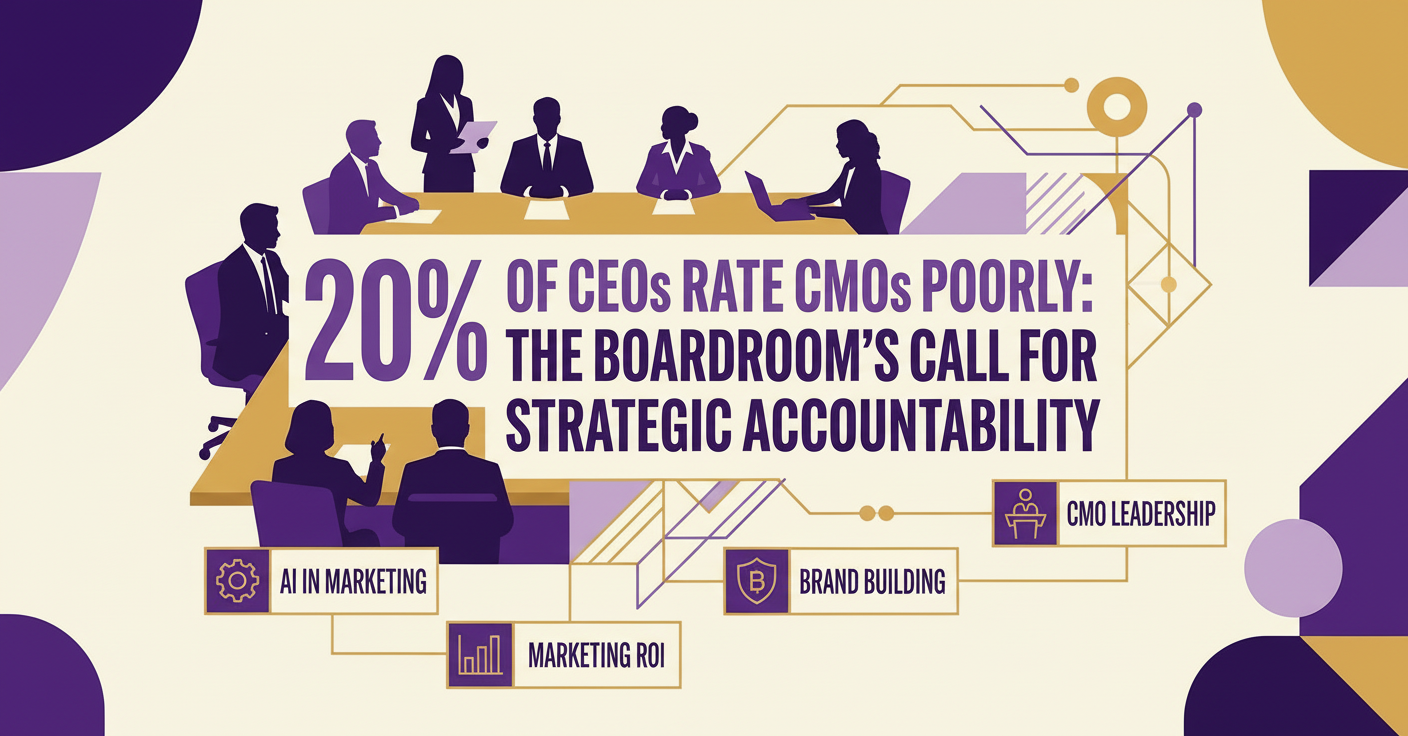
Thomas Barta, CEO of the Marketing Leadership Institute, revealed a sobering statistic on Uncensored CMO: "Only 20% of CEOs rated their CMO as delivering growth for the company." This isn't just a perception gap; it's a strategic chasm. The expectation is clear: CMOs must drive profitable business growth. Yet, many struggle to articulate their contribution in terms their peers value.
The solution isn't just better reporting; it's a fundamental shift in mindset. As Jon Evans, host of Uncensored CMO, emphasized, "If your CFO is explaining why you should invest in marketing, you've done the job." This transcends mere alignment; it’s about embedding marketing’s value proposition so deeply that finance becomes its advocate. It requires moving beyond creative execution to genuine value creation, understanding the business model, and speaking the language of P&L. Orla Mitchell, speaking on That's What I Call Marketing, echoed this shift: "To succeed at the highest levels, you need the right and the left brain working together... That kind of shift into the accountability and responsibility for value creation and value generation, what that was probably that shift in my career."
This isn't about compromising creativity; it's about making it accountable. It involves setting clear action standards, embracing a scientific, data-based approach (as Mitchell championed, influenced by Ehrenberg-Bass principles), and, crucially, having the courage to challenge the status status quo. Sharon Price John, CEO of Build-A-Bear Workshop, encapsulated this on Marketing Vanguard: "I expect everyone that's going to sit at that table to come to the challenge with a business mindset, not a marketing mindset or an advertising mindset." The boardroom awaits, but it demands more than just campaigns—it demands growth.
💡 IDEAS IN BRIEF
- The Power of Intentional Irreverence: Daniel Groh, CBO of **Satisfy**, highlighted how their premium running brand intentionally avoids benchmarking competitors, believing "The easiest way to do something quite different is to not look at anything at all" on Scratch: CMO Interviews. This contrarian strategy underlines the power of carving unique brand worlds rather than chasing trends.
- Relevance Over Awareness, Amplified by AI: In an era of hyper-dynamic markets, David Aaker, author of "Aaker on Branding," argues that "relevance means that you, you need visibility... with respect to the new context" and credibility, rather than just awareness, on Brand Master Podcast. AI magnifies this need, demanding brands create "must-haves" that offer superior user experiences or new relationships.
- Localizing Global Playbooks:Amazon Business Australia country manager, Lena Zak, explained on The CMO Show how they adapted global strategies to the local "human-to-human" business culture, with whimsical campaigns like "Little Bo Peep" proving more effective than typical B2B approaches. Authenticity and cultural nuance trump global uniformity.
- Creative Endurance: Orla Mitchell, a seasoned marketing leader, shared on That's What I Call Marketing that "Good creative is incredibly difficult to crack and it doesn't wear out as fast as people [think]." Her experience reusing effective creative for years challenges the industry's often short-sighted pursuit of novelty for novelty's sake.
- AI as a Leadership Test: Karin Timpone, CEO of ClearPrompt, speaking on Marketing Vanguard from Davos, positioned AI adoption as a leadership test for CMOs, emphasizing connection to business outcomes and a phased approach. Joshua Spanier, VP of AI and Marketing Strategy at Google, built on this, stating "AI sucks the most it will ever suck. Today, right now, tomorrow AI is going to be better," advocating for fundamental changes in how marketing teams work, not just tool usage.
⚡ THE TENSION: Short-Term Outcomes vs. Long-Term Brand Building
The shift from "eyeballs to outcomes" in media measurement is creating a legitimate tension between immediate, finance-relevant results and the sustained effort of brand building. On The WARC Podcast, Sameer Modha of ITV and Kate Brinkley of The Specialist Works dissected this, noting that big tech platforms have accelerated outcome-based measurement, giving marketers direct lines to sales. Modha stressed, "We need to measure better, not lecture harder," pushing for transparent, outcome-focused metrics.
However, this focus can be a double-edged sword. Alex Brownsell, host of The WARC Podcast, cautioned: "If you measure in the really short term, you’re fucked, because it’s going to look terrible, particularly compared to all that lovely platform stuff." The danger lies in losing sight of long-term brand equity, which doesn't always show up in immediate sales figures. This echoes David Aaker’s point on Brand Master Podcast that brand equity is built through "continuity and consistency." The paradox is acute: while short-term outcomes satisfy the boardroom, long-term brand building ensures there's a business worth measuring.
🎯 BRAND OF THE WEEK: Satisfy
**Satisfy**, the Parisian technical running apparel brand, epitomizes brand alchemy. Co-founder Daniel Groh, speaking on Scratch: CMO Interviews, explained their "incubation model," where concepts like "Long Slow Distance" or "Possessed" magazine build a "Satisfy world" over 18+ months. They treat customers as "guests" and hire for culture first, delivering an authentic, premium experience that justifies their price point through unique materials, advanced construction, and an unapologetic focus on "pinnacle customers." In a category flooded with giants, **Satisfy** proves that a deeply owned, patiently cultivated brand narrative can create fierce loyalty and carve out a distinct, adored niche.
📚 THE APPENDIX — EPISODE GUIDE
1. Scratch: CMO Interviews: "How Satisfy Built The Most Adored Brand In Running"
Guests: Daniel Groh (Chief Brand Officer, Satisfy), Eric Fulwiler (Host, Rival), Daniel Pineda (Unspecified, Satisfy)
Runtime: 45m | Vibe: The counter-intuitive artistry of premium brand building.
Key Signals:
- Brand Incubation Model: **Satisfy** builds concepts over 18+ months, like "Long Slow Distance" runs, integrating new ideas gradually to ensure authenticity and long-term relevance.
- Hospitality Mindset: They refer to customers as "guests" and focus on creating a welcoming "Satisfy world," emphasizing culture and experience over competitive benchmarking.
"The easiest way to do something quite different is to not look at anything at all." — Daniel Groh, Chief Brand Officer, Satisfy
2. Uncensored CMO: "Why Marketers Don’t Make the Boardroom - Thomas Barta"
Guests: Jon Evans (Host, Uncensored CMO), Thomas Barta (CEO of the Marketing Leadership Institute, Former McKinsey Partner, Co-author of The 12 Powers of a Marketing Leader, Marketing Leadership Institute)
Runtime: 38m | Vibe: An urgent call for CMOs to prove their growth impact.
Key Signals:
- Boardroom Relevance Gap: Only 20% of CEOs rate their CMOs highly for growth contribution, highlighting a critical disconnect in marketing's perceived value at the top.
- Bravery Formula: "Bravery is purpose minus fear"—a framework for CMOs to overcome internal resistance and mobilize big, growth-driving ideas by grounding them in clear purpose.
"So you saying that only 20% of CEOs rated their CMO as delivering growth for the company." — Thomas Barta, CEO of the Marketing Leadership Institute, Former McKinsey Partner
3. The WARC Podcast: "What's actually working in sports marketing"
Guests: Anna Hamill (Host, WARC), Vaniele Casimir (Editor and Author of 'What\'s Working In Sports Marketing' report, WARC)
Runtime: 16m | Vibe: Decoding the evolving playbook for engaging sports fans.
Key Signals:
- Rise of Athlete-Creators: Especially prominent in women's sports, athlete-creators are driving authentic engagement and offering new avenues for brand partnerships.
- Comprehensive Content Ecosystems: Brands must treat sporting events as catalysts for long-term activations across fragmented media channels, building year-round relationships.
"One of the most interesting trends, I think is the rise of the athlete creator. That's a huge trend in 2026 and there's a really big opportunity here. I think especially in women's sports, they're really leading the charge in this area." — Anna Hamill, Host, WARC
4. Brand Master Podcast: "307 | Why Relevance Wins in the Age of AI with David Aaker"
Guests: Stephen Houraghan (Host, Brand Master Podcast), David Aaker (Author of Aaker on Branding), Kirsten Acker (Questioner on Employer Branding), Gemma (Questioner on Purpose-Driven Brands), Gail (Audience Member)
Runtime: 68m | Vibe: The enduring power of brand meaning in a disruptive world.
Key Signals:
- Relevance Over Awareness: In a hyper-dynamic market amplified by AI, brands must focus on being visibly and credibly relevant, offering "must-haves" that solve customer problems or improve their lives.
- Branded Social Programs: Signature purpose-driven initiatives, like **Dove Real Beauty**, are crucial for attracting talent and enhancing brand equity, provided they are credible and long-term.
"Relevance means that you, you need visibility with respect to the, the new context. And in most cases we're worried about this disruptive innovation... And the second thing is that even if they think about it, is it credible? It has to be visible and credible." — David Aaker, Author of Aaker on Branding
5. The CMO Show: "Rethinking B2B: Amazon's unexpected Aussie marketing lessons"
Guests: Lena Zak (Country Manager, Amazon Business Australia), Mark Jones (Host, ImpactInstitute)
Runtime: 29m | Vibe: Mastering local nuances in global B2B strategy.
Key Signals:
- Localized B2B Strategy: **Amazon Business** had to adapt its global playbook in Australia, focusing on "human-to-human" trust-building and localized campaigns (like "Little Bo Peep") to address specific market friction.
- Amazon's Writing Culture: The company's unique emphasis on written communication (e.g., 6-page memos) is key to its success, driving clarity and alignment in decision-making.
"Australia is super unique in a lot of ways. Building a brand here and earning the trust of business stakeholders is so key." — Lena Zak, Country Manager, Amazon Business Australia
6. The WARC Podcast: "Media's shift from eyeballs to outcomes"
Guests: Alex Brownsell (Head of Content, WARC), Sameer Modha (Leader of the Outcome Measurement Innovation Team, ITV), Kate Brinkley (Head of Digital Planning, The Specialist Works)
Runtime: 47m | Vibe: Demystifying measurement in the age of AI and outcomes.
Key Signals:
- Outcome-Based Measurement: Media measurement is rapidly shifting from traditional exposure metrics to finance-relevant business outcomes, driven by big tech platforms and AI/ML capabilities.
- Blended Measurement Approach: The demand for immediate outcomes requires a hybrid approach, balancing short-term tactical wins with long-term brand effects, exemplified by **Project Lantern**'s focus on multi-pillar measurement.
"A very blunt definition [of outcomes] might be something that a finance person's going to care about because that interface of marketing function to finance function is a critical one." — Sameer Modha, Leader of the Outcome Measurement Innovation Team, ITV
7. Marketing Vanguard: "Successfully Using AI in Business with ClearPrompt CEO, Karin Timpone, at the World Economic Forum Event"
Guests: Jenny Rooney (Host, Adweek), Karin Timpone (CEO and Founder, ClearPrompt)
Runtime: 18m | Vibe: CMOs stepping into their power as AI strategists.
Key Signals:
- CMOs as AI Leaders: CMOs are uniquely positioned to lead AI strategy due to their versatile skill sets and understanding of customer experience, advocating for a phased, outcome-focused implementation.
- ClearPrompt's AI Tool: Karin Timpone developed **ClearPrompt** to help CMOs translate business strategy directly into marketing plans, integrating AI to ensure alignment across the C-suite.
"I think CMOs are really among the most versatile executives that exist and really have to think about every part of the experience of not just their custom, but their teams and how they're going to execute." — Karin Timpone, CEO and Founder, ClearPrompt
8. That's What I Call Marketing: "S5 Ep6: Marketing Masterclass with Marketing Leader Orla Mitchell"
Guests: Conor Byrne (Host, That's What I Call Marketing), Orla Mitchell (Marketing Leader (former CEO of WaterWipes), Nestlé, Kerry Foods, Mars Wrigley, WaterWipes)
Runtime: 48m | Vibe: The evolution of marketing from art to science.
Key Signals:
- Science-Based Marketing: Orla Mitchell’s shift to scientific, data-driven marketing (influenced by Ehrenberg-Bass principles) transformed her approach, focusing on penetration and effective creative testing.
- Enduring Creative Excellence: Good creative has a much longer shelf life than commonly assumed, allowing for reuse over years and demonstrating the importance of "cracking" truly effective campaigns.
"Marketing now is more scientific, is more data based because unfortunately it was too opinion based for too long... At least now there are more metrics and more measurability which was sadly missing in the early days." — Orla Mitchell, Marketing Leader
9. On Brand with Nick Westergaard: "Designing with Emotional Friction"
Guests: Lee Hoddy (Executive Creative Director, Conran Design Group), Nick Westergaard (Host)
Runtime: 31m | Vibe: Crafting human-centric brand experiences.
Key Signals:
- Experience-Led Design: **Conran Design Group** uses emotional mapping of customer journeys to identify "moments of friction" and opportunities, shaping brand perception through deeply understood human needs.
- Originality in an AI World: In a world of increasing AI-generated content, original ideas and bespoke experiences become increasingly valuable to cut through the "sea of sameness."
"We're looking to uncover the moments in the experience that can really shape the perception of a brand. So typically, you'd start a project, you might look at the sort of key signatures or touch points, but really getting into that sort of emotional mapping and understanding those sort of moments of friction and experience are the sort of sort of where the gold is really, I think, in terms of building a brand." — Lee Hoddy, Executive Creative Director, Conran Design Group
10. Marketing Vanguard: "Brandweek 2025: How Build-A-Bear’s Sharon Price John Made the CMO to CEO Jump Flawlessly"
Guests: Jenny Rooney (Host, Adweek), Sharon Price John (CEO, Build-A-Bear Workshop), Joshua Spanier (VP of AI and Marketing Strategy, Google), Adweek (Host, Adweek)
Runtime: 38m | Vibe: From marketing strategist to enterprise leader.
Key Signals:
- Business-First Mindset: Sharon Price John, CEO of **Build-A-Bear Workshop**, transitioned from CMO to CEO by cultivating a business-first approach, emphasizing profitable growth and problem-solving over a singular marketing focus.
- CMO to CEO Path: She advocates for embracing "turnaround" roles as valuable pathways to CEO experience, offering a lower-risk, higher-reward route to leadership.
"I expect everyone that's going to sit at that table to come to the challenge with a business mindset, not a marketing mindset or an advertising mindset. What are we trying to solve? Think about it from a financial perspective. We're always trying to grow profitably." — Sharon Price John, CEO, Build-A-Bear Workshop
11. The CMO Podcast: "Emily Silver (Dick’s Sporting Goods) | Sports, Leadership, and Thriving Through Change | From the Vault"
Guests: Jim Stengel (Host, The CMO Podcast), Emily Silver (SVP, Chief Marketing, eCommerce & Athlete Experience Officer, Dick's Sporting Goods), Jim (Host, The CMO Podcast), Andrea Sullivan (CEO, VIVE), Jonathan Mildenhall (CMO), Kate (Dick's Sporting Goods), Josh (Dick's Sporting Goods), David Shingy, Rob Jensen (Steel), Amit
Runtime: 49m | Vibe: Leadership, sports, and transformation at scale.
Key Signals:
- From Retailer to Sports Company: Emily Silver, CMO at **Dick's Sporting Goods**, is steering the company's transformation from a traditional sports retailer to "the best sports company in the world," enabled by technology and a focus on athlete experience.
- Leadership in Transition: New leaders should "learn, sit, understand and then figure out where you want to lean in" before making changes, emphasizing observation and strategic patience.
"This idea of going from a sports retailer to the best sports company in the world is something that we're all incredibly passionate about. It's truly enabled by technology." — Emily Silver, SVP, Chief Marketing, eCommerce & Athlete Experience Officer, Dick's Sporting Goods
12. Renegade Marketers Unite: "506: Positioning as a Growth Lever"
Guests: Drew Neisser (Host and Chief Marketing Renegade, Renegade Marketers Unite), Bob Wright (Founder, Firebrick Consulting), Drew (Host, CMO Huddles), Bob Apollo (Founder, Firebrick)
Runtime: 51m | Vibe: Sharpening your brand's competitive edge for revenue.
Key Signals:
- Problem-Centric Positioning: B2B positioning must move beyond product-centric "feature function decks" to articulate "why you matter" to the buyer, explicitly owning a problem they care about.
- CEO-Driven Positioning: Effective repositioning requires strong CEO buy-in, as it's a company-wide initiative that impacts everything from employee motivation to market perception.
"The number one mistake that I see of positioning is it's all about you. It's product centric. Your feature function decks are not moving the needle." — Bob Wright, Founder, Firebrick Consulting