
Welcome to The Playbook, the weekly tactical injection for CMOs who own their numbers. This week, we're cutting through the noise to focus on what's *actually* driving pipeline and revenue. We're talking real-world case studies, shifts in channel efficacy, and the hard data proving what works — and what doesn't. Forget vague brand philosophy; this is about the execution engine.
The Intake
This week, we crunched 12 episodes across 8 podcasts, totaling 382 minutes of raw insight. We pulled 20 surprising insights and identified 0 active debates, signaling a growing consensus around a few key operational shifts. Our top voices included Ralph Burns (Tier 11), Casey Stanton (Fractional CMO Show), and Christopher Penn (Marketing Over Coffee) & John Wall (Marketing Over Coffee), bringing their on-the-ground experience to the forefront.
Big Idea: The Meta-Google Synergy & the Death of Last-Click Attribution
For CMOs obsessed with a revenue number, the relentless pursuit of new customer acquisition cost (NCAC) efficiency is paramount. This week, Ralph Burns, Founder and CEO of Tier 11, dropped a masterclass in multi-channel alchemy that should rattle any marketer still clinging to last-click vanity metrics.
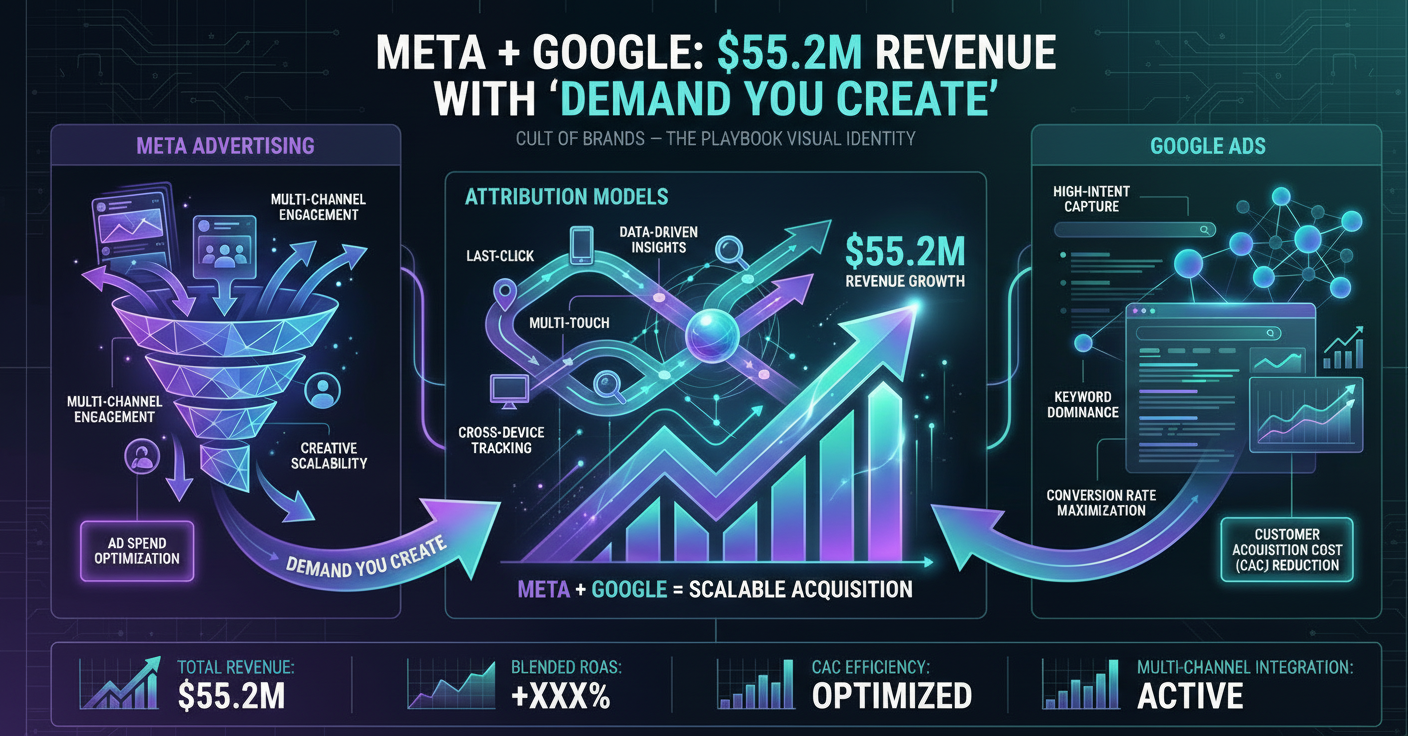
In a detailed case study (Perpetual Traffic, 51m), Burns showcased how his agency took a personal injury law firm from zero tracking and a fragmented strategy to a staggering $55.2 million in generated revenue over three years. The secret? A synergistic ad strategy blending the demand creation power of Meta with the intent capture of Google Ads, all backed by obsessive offline tracking and a ruthless focus on NCAC.
The firm, Mike Morse Law, initially struggled with a $1,500 cost per signed case and no clear attribution. Tier 11 stepped in, identifying the critical flaw: a reliance on Google to both create and capture demand, and a complete lack of tracking for Meta's contribution. By integrating Meta for top-of-funnel awareness ("Post-Accident Amy") and Google for intent-driven conversions ("Accident Andy"), they didn't just optimize; they transformed.
"Google is no longer a primary driver for a lot of businesses... it's the synergy between all the different platforms. Google really just captures the demand that you create somewhere else." — Ralph Burns, Founder and CEO of Tier 11
This isn't just about channels; it's about shifting your mental model. Burns underscores that Google, with its 72 million data points per person (and likely 10x more now with AI), is a powerful demand capture engine, but it often feeds on demand created elsewhere. The 20x ROI they achieved was not from a single channel, but from understanding the customer journey and assigning the right role to each platform.
Crucially, Tier 11 implemented a robust offline tracking system, moving beyond last-click metrics to understand the true blended NCAC. They brought the cost per signed case down to $1,518, generating $11 million in revenue from those cases alone. This isn't just theory; it's a blueprint for how a growth-stage CMO should be thinking about their media mix and attribution in a post-iOS 14 world.
"The problem was is that the tracking wasn't set up properly. We weren't feeding the algorithm enough data to attract the type of car accident signed cases that they really wanted." — Ralph Burns, Founder and CEO of Tier 11
The takeaway for you, the CMO owning a revenue number, is clear: stop treating Meta and Google as independent silos. They are complementary forces in your demand gen engine. Your role is to orchestrate their synergy, capture the full picture of their impact through robust tracking, and optimize for the blended NCAC that drives your P&L.
Ideas in Brief
Beyond Sponsorships: Building Your Own Experiences for Brand & Talent:Tech Mahindra CMO Peeyush Dubey (Pipeline Visionaries, 46m) revealed how the $6.2 billion B2B company built its own Global Chess League instead of traditional sponsorships. This flagship initiative drove marketing, customer experience, and talent branding, becoming an "uncuttable innovation budget" item. It emphasizes that building owned experiences can create far more authentic and impactful connections than simply putting your logo on someone else's stadium.
"Instead of having our logo only on a stadium and paying in many cases millions of dollars for that, how do we build our own league?" — Peeyush Dubey, Chief Marketing Officer at Tech Mahindra
B2B Brand Building with Scrappy Content & Strategic Emotion:Rippling's VP of Marketing Ryan Narod (The Dave Gerhardt Show, 48m) shared how they built a formidable B2B brand by shifting from growth marketing to human-first content. Their strategy? Making HR professionals the "hero" and using scrappy, iPhone-shot social videos that often outperform high-production value content. They even leveraged LinkedIn partners to get an "HR Love Songs" video campaign effectively for free. This proves that impact isn't always tied to budget.
"The thing that costs order of magnitude more doesn't actually outperform by an order of magnitude. Like in many cases, this social thing will do just as well as the thing that is high production value." — Ryan Narod, VP of Marketing at Rippling
The Rise of the AI Agent and the Disappearing Marketing Middle:Casey Stanton (Fractional CMO Show, 32m) predicts that AI agents like Manus (Marketing Against The Grain, 25m) are not external tools but integrated labor, driving an "embarrassing" compression of speed to insights and workforce shrinkage. The "marketing middle," including many agencies, is disappearing as AI automates commodity work. Meta's Manus AI agent, using "skills" (system-level instructions) that are universal across AI systems, can integrate with email, Telegram, and other platforms to automate complex workflows. This is the future of AI-powered leverage.
"What we're all after is this collapsing of the technology so that there are no walls between me and it." — Casey Stanton
AI for Revenue Growth, Not Just Cost Cutting:Neil Patel and Eric Siu (Marketing School, 21m) cut through the AI-for-efficiency hype. While Eric's OpenClaw setup autonomously generates X articles averaging 100,000 views, the real opportunity for large corporations isn't saving a few million in SaaS spend (8-12% of enterprise spend). It's using AI to grow revenue by billions. Your CEO shouldn't be focused on a $10 million saving when $1 billion in growth is on the table.
"If you're a CEO of a company that's publicly traded doing billions and billions of dollars in revenue a year, why are you focused on saving less than $10 million when you should be figuring out how to grow from 4 billion in revenue to 5 or 6 billion in revenue?" — Neil Patel, Host of Marketing School
The Agentic AI CMO: From Pilots to Productivity: Forget the 95% generative AI pilot failure rate. Salesforce CMO Ariel Kelman (MarTech Podcast, 45m) revealed how AgentForce resolves 77% of customer support cases, saving $100 million and generating $27 million in pipeline by processing unworked leads. The secret sauce? Deep data context and executive modeling of AI use. Marketers will be "embarrassed" by manual video creation in five years, with Salesforce creating animated flythroughs of four event spaces in six hours with AI. This is about task automation, not human replacement.
"Overall we've resolved 77% of all the customer support cases using Agent Force. And then that's let us save over $100 million." — Ariel Kelman, President and CMO of Salesforce
Tactic of the Week: Creative Diversification & Lo-Fi Native Ads on Meta
For e-commerce CMOs, boosting revenue from $5M to $32M in two years is the dream. Ralph Burns (Perpetual Traffic, 37m) detailed how his team achieved this for a client by weaponizing creative diversification on Meta. Key tactics: cutting age targeting for the 65+ demographic to avoid wasted spend, focusing 100% of the budget on the hero product (despite client pressure for diversification), and pivoting from polished branding to "ugly lo-fi," native-style ads featuring younger demographics. This counter-intuitive move, driven by Tier 11's Data Suite to capture true blended NCAC, significantly improved performance where algorithms failed. The lesson: trust your data, not your creative director's ego, and embrace the authentic.
The Tension: ABM Effectiveness – Digital vs. IRL
The classic brand vs. performance debate manifests sharply in the world of Account-Based Marketing (ABM). While the allure of hyper-targeted digital campaigns is strong, this week's discussions present a nuanced (and at times, contrarian) view on what actually moves the needle for high-value accounts.
Brian Kotlyar, CMO at Hightouch (The Dave Gerhardt Show, 50m), shares compelling data: their ABM treatment group converts from unengaged to a stage one opportunity at a 32% higher rate, and from stage one to stage two at a 38% higher rate compared to a control group. This validates the fundamental premise of ABM. However, he then makes a surprising admission:
"We're stopping paid social ads for ABM brand awareness...it can quickly just morph into targeted demand gen. And we found it's not super effective." — Brian Kotlyar, CMO at Hightouch
This is a direct challenge to the conventional wisdom of using digital channels for ABM awareness. Kotlyar argues that digital channels are becoming "over-saturated," leading to diminishing returns. His preferred alternative?
"The highest efficacy thing is stuff that's not on the Internet, it's talking to them in real life." — Brian Kotlyar, CMO at Hightouch
This sentiment is echoed by Casey Patterson, Director of ABM at Snowflake, who emphasizes that sales reps' intimate knowledge of accounts often overrides data science models. While intent data is valuable, a sales rep might know an account isn't ready to buy for years due to existing contracts, a truth that no amount of digital targeting can circumvent.
The playbook here is shifting. Instead of broad digital campaigns, ABM leaders like those from Ramp, Snowflake, and Hightouch are embracing ultra-exclusive in-person events (think Super Bowl suites, Beyonce concerts), personalized direct mail with high-value offers, and targeted lunch-and-learns. The emphasis is on quality over quantity, and direct human connection over pixel-based impressions.
For the growth-stage CMO, this means a critical audit of your ABM spend. Are you investing heavily in paid social for ABM awareness only to see it "morph into targeted demand gen" with high costs and unclear ROI? It might be time to reallocate those budgets to more direct, high-touch, and crucially, offline experiences that build real relationships and influence purchase decisions. The tension isn't about abandoning digital entirely, but about refining its role and acknowledging its limitations in the face of digital fatigue for your most valuable accounts.
Appendix
1. MarTech Podcast ™ // Marketing + Technology = Business Growth: "The Agentic Evolution according to Salesforce’s CMO"
Guests: Ariel Kelman (President and Chief Marketing Officer, Salesforce), I Hear Everything (Host, I Hear Everything Podcast Network), Jeff Rain (Founder, Everything Machines)
Runtime: 45m | Vibe: The Future is Automated, Not Replacement
Key Signals:
CMO Role in AI Adoption: Successful AI implementation hinges on executive leadership modeling AI tool usage and a strong data foundation for context. The 95% failure rate of generative AI pilots stems from a lack of data context and change management, not technical limitations.
"One of the biggest keys to success is having the executives and all the different, the leaders of the different marketing teams use the AI tools on their own and model that behavior for the rest of the team." — Ariel Kelman, President and CMO of Salesforce
AI Agent ROI: Salesforce's AgentForce resolved 77% of customer support cases, saving over $100 million and generating $27 million in incremental pipeline by processing previously unworked leads with AI-driven lead qualification. This showcases direct revenue impact from agentic AI.
"Overall we've resolved 77% of all the customer support cases using Agent Force. And then that's let us save over $100 million." — Ariel Kelman, President and CMO of Salesforce
2. Marketing School - Digital Marketing and Online Marketing Tips: "How OpenClaw Creates 100k view X Articles"
Guests: Eric Siu (Host, Marketing School), Neil Patel (Host, Marketing School)
Runtime: 21m | Vibe: Monetizing AI Content & Strategic Growth
Key Signals:
AI for Enterprise Revenue vs. Cost-Cutting: Neil Patel argues large corporations should prioritize AI for top-line revenue growth, not minor cost savings. Rebuilding core SaaS tools with AI for 8-12% spend savings is a misdirection from potential billion-dollar revenue opportunities.
"If you're a CEO of a company that's publicly traded doing billions and billions of dollars in revenue a year, why are you focused on saving less than $10 million when you should be figuring out how to grow from 4 billion in revenue to 5 or 6 billion in revenue?" — Neil Patel, Host of Marketing School
AI Content Monetization: Eric Siu's OpenClaw setup autonomously generates X articles that average 100,000 views per post, demonstrating a profitable model for AI-generated content beyond just reach.
"OpenClaw is literally writing me articles right now on X. And it's averaging about a hundred thousand views per post. This is what actually makes them profitable. Not a lot of people are talking about how they make money with this." — Eric Siu, Host of Marketing School
3. Perpetual Traffic: "How We Made a Personal Injury Law Firm $55.2M (Case Study)"
Guests: Ralph Burns (Founder and CEO, Tier 11)
Runtime: 51m | Vibe: Multi-Channel Mastery for 20x ROI
Key Signals:
Data-Driven Attribution: Robust offline tracking fed proper data to the algorithms, allowing for optimization beyond last-click attribution and attracting the desired high-value cases. Google primarily captures demand created elsewhere.
"The problem was is that the tracking wasn't set up properly. We weren't feeding the algorithm enough data to attract the type of car accident signed cases that they really wanted." — Ralph Burns, Founder and CEO of Tier 11
Multi-Channel Synergy: Tier 11 achieved a 20x ROI for a personal injury law firm, generating $55.2M in revenue, by integrating Meta for awareness and Google for conversions. This reduced the cost per signed case to $1,518 (from an average settlement of $60,000).
"If you are getting 30% of that settlement, that really backs out quite nicely. So $1,500 per case, 628 cases. The revenue for the firm is well over $11 million in revenue." — Ralph Burns, Founder and CEO of Tier 11
4. Fractional CMO Show: "I found the future of AI for CMOs"
Guests: Casey Stanton (Host, Fractional CMO Show)
Runtime: 32m | Vibe: AI as Integrated Labor, Not External Platform
Key Signals:
Disappearing Marketing Middle: AI's automation of commodity work is causing the rapid shrinkage of the marketing industry's "middle," where many agencies reside. High-level strategy and creative will remain in demand.
"I really think that's going to be a fundamental shift in replacing human laborers." — Casey Stanton
Integrated AI Agents: Casey Stanton emphasizes that the future of AI for CMOs lies in agents integrating directly into existing work platforms (Slack, email) as "labor," rather than external platforms. This speeds up personalization and insights, leading to workforce shrinkage.
"What we're all after is this collapsing of the technology so that there are no walls between me and it." — Casey Stanton
5. MarTech Podcast ™ // Marketing + Technology = Business Growth: "Marketers will be embarrassed they used to do manually"
Guests: I Hear Everything (Host, I Hear Everything), Ariel Kelman (President and CMO, Salesforce)
Runtime: 5m | Vibe: The End of Manual Video Production
Key Signals:
Exponential AI Improvement: The rapid advancement of AI video editing tools, improving exponentially every six weeks, is making traditional costly filmed TV ads obsolete at an unforeseen pace.
"We just been able to generate things that are incredibly high quality that previously would have required, you know, a massive amount of people and time and money." — Ariel Kelman, President and CMO of Salesforce
AI-Driven Video Production: Ariel Kelman (President and CMO, Salesforce) predicts marketers will be embarrassed by manual video creation in five years. Salesforce used AI to create a complete animated flythrough of four event spaces in just six hours, a task impossible traditionally.
"In five years, what will marketers be embarrassed that they used to do manually? I mean, I'm going to say spend large amounts of money on traditional filmed TV ads." — Ariel Kelman, President and CMO of Salesforce
6. Marketing Over Coffee Marketing Podcast: "Year of the Horse Triggers AI Race!"
Guests: Christopher Penn (Host, Marketing Over Coffee), John Wall (Host, Marketing Over Coffee)
Runtime: N/A | Vibe: The AI Cost Disruption
Key Signals:
AI-Generated Content Economic Viability: The cost to produce an AI-generated novel can be as low as $12 in API credits, yielding positive ROI on platforms like Kindle Unlimited. This challenges traditional publishing economics and enables AI-powered entrepreneurship.
"What's really interesting is that the East Asian AI companies are all still going the open weights route. So what that means is Kimik 2.5, GLM5 and corporations when 3.5 are free, you can, if you have the hardware to run them, to download them, they are free." — Christopher Penn, Host at Marketing Over Coffee
East Asian AI Open-Weights Advantage: Christopher Penn highlights that East Asian AI companies continue to offer open-weights models with significantly lower API costs (e.g., GLM 5 for 22 cents vs. Claude Opus for $11 for the same task), democratizing advanced AI access.
"Claude Opus the task cost in API costs would be $11 for this particular task. GLM 522 cents. So same power, same capability, much different price." — Christopher Penn, Host at Marketing Over Coffee
7. Marketing Against The Grain: "Meta’s AI Agent is Better Than OpenClaw (Manus AI Demo)"
Guests: Kipp Bodnar (Host, HubSpot), Kieran Flanagan (Host, HubSpot)
Runtime: 25m | Vibe: The Power of AI 'Skills'
Key Signals:
AI Agent Cost Consideration: While powerful, heavy usage of advanced AI agents, especially for image generation or data access from services like SimilarWeb, will incur significant costs for marketers.
"The only caveat I'd give Kieran is you will probably spend some money if you really start using this heavily. Especially if you're making any images or if you are accessing data from similar web. Anything that Manus has that's really valuable but also has like a real cost associated to it." — Kipp Bodnar, Host at HubSpot
Manus AI's "Skills" Advantage: Meta's Manus AI agent surpasses OpenClaw in ease of use, leveraging "skills" (system-level instructions) that are universally portable across AI systems. These skills enable autonomous task automation across platforms like Telegram and email.
"Skills are the most important aspect of learning AI this year. Skills is basically a system, whereas prompt is conversation. You teach the AI a core skill that is a system skill." — Kieran Flanagan, Host at HubSpot
8. Marketing Against The Grain: "770,000 Agents, 0 Humans: Inside the First AI Social Network"
Guests: Kieran Flanagan (Host, Hubspot Media), Peter Steinberger (Developer, OpenAI), Andre Karpathy (AI Researcher, Undisclosed), David Sacks (Venture Capitalist, Former Founder and CEO, All In Podcast), Eric Su (Well-known in the growth marketing space, Clickflow), Banu TJP (Programmer, Undisclosed), Matt Schlil (CEO, Oqtane AI)
Runtime: 22m | Vibe: AI Agents Building Their Own World
Key Signals:
OpenClaw's Rapid Growth & Real-World Use: OpenClaw achieved over 100,000 GitHub stars faster than any preceding project, showcasing massive interest. Non-technical users are running significant parts of their businesses with it, despite security concerns, by delegating to AI rather than just talking to it.
"Open Claw is an AI agent that works for you, right? It runs on your computer or a server that you can control. It connects to a messaging platform so it can connect to WhatsApp, Slack, Telegram, Discord. Most early users connect it to Telegram so they can use Telegram to tell IT things and ask it to do work for them. And it does that work autonomously so you don't have to continue to check in." — Kieran Flanagan, Host at Hubspot Media
Autonomous AI Social Network: An OpenClaw agent, without human coding, built Moltbook, a social network exclusively for other AI agents. It accumulated 770,000 agent users in two weeks, demonstrating AI's capacity for self-organizing ecosystems.
"Steinberger had a philosophical question, you know, what happens if you give it a purpose beyond managing to do lists? And he told his agent, whom he named Claude, Claude, to build a social network, not for humans, for agents. And it went off and it built Malt Book." — Kieran Flanagan, Host at Hubspot Media
9. The Dave Gerhardt Show (from Exit Five): "How to Build a Brand in B2B with Ryan Narod (VP of Marketing at Rippling)"
Guests: Dave Gerhardt (Host, Exit Five), Ryan Narod (VP of Marketing, Rippling)
Runtime: 48m | Vibe: Human-First, Scrappy B2B Brand Building
Key Signals:
Organic-Paid Integration: Rippling created an "HR Love Songs" video campaign effectively for free by leveraging LinkedIn's value-added partners. This demonstrates creative budget-conscious marketing that integrates organic and paid efforts for impact.
"If you look at our old version of our blog, every blog post was authored by the Rippling team and it's like, who is that? And there was no style and there was no voice. And so I think part of it was like we staffed the team. I started hiring for all these people with weird, wacky profiles that were comfortable being on camera and being the face of the company." — Ryan Narod, VP of Marketing at Rippling
Human-First B2B Branding: Rippling's VP of Marketing Ryan Narod built their B2B brand by making HR professionals the "hero" and focusing on authentic, human-centric content, even using scrappy, iPhone-shot videos that perform as well as high-production value material.
"The thing that costs order of magnitude more doesn't actually outperform by an order of magnitude. Like in many cases, this social thing will do just as well as the thing that is high production value." — Ryan Narod, VP of Marketing at Rippling
10. Perpetual Traffic: "From $5M to $32M in 2 Years [Premium eCommerce Case Study]"
Guests: Ralph Burns (Founder and CEO, Host, Tier 11), Tier 11 (Host, Tier 11)
Runtime: 37m | Vibe: Aggressive eComm Scale via Creative Ops
Key Signals:
Holistic Attribution for iOS 14 Blindness: The Tier 11 Data Suite mitigated iOS 14 blindness, providing a holistic view of channel attribution beyond last-click. This allowed accurate tracking of blued platform performance and data-driven creative decisions.
"The beauty with Tier 11 Data Suite is it mitigates or almost completely eliminates that blindness that iOS 14 started and pop-up blockers and all the other privacy issues that we've had." — Ralph Burns, Founder and CEO of Tier 11
Creative Diversification for Scale: Tier 11 scaled an e-commerce brand from $5M to $32M in two years by cutting Meta age targeting for older demographics and focusing on "ugly lo-fi" native-style ads. They prioritized a hero product and used their Tier 11 Data Suite to improve blended NCAC.
"Creative diversification is the key to everything that we're doing right now and will be into the foreseeable future, especially as Meta is the number one platform that we utilize in order to scale and grow businesses." — Ralph Burns, Founder and CEO of Tier 11
11. Pipeline Visionaries: "Why This $6B B2B Company Built a Chess League"
Guests: Peeyush Dubey (Chief Marketing Officer, Tech Mahindra), Ian Faison (CEO & Host, Caspian Studios), Ian (Host, Pipeline Visionaries), Piyush Chowhan (CMO, Tech Mahindra)
Runtime: 46m | Vibe: B2B Experience Ownership
Key Signals:
"Uncuttable" Innovation Budget: Peeyush Dubey allocates 5-10% of his marketing budget for innovation and experiments, deeming it "uncuttable." This ensures continuous testing and evolution of strategy, even in lean times.
"The third, which a budget that I normally never touch is the budget for innovation. Now that is the budget, no matter how good or how bad the time is, you gotta have at least 5 to 10% of your budget as the CMO just for experiments that you're doing." — Peeyush Dubey, Chief Marketing Officer at Tech Mahindra
Owned Experiences as Marketing Platforms: Tech Mahindra (a $6.2 billion B2B company) built its own Global Chess League as a flagship marketing, customer experience, and talent branding platform, demonstrating the power of building owned experiences over traditional sponsorships.
"Instead of having our logo only on a stadium and paying in many cases millions of dollars for that, how do we build our own league?" — Peeyush Dubey, Chief Marketing Officer at Tech Mahindra
12. The Dave Gerhardt Show (from Exit Five): "ABM: What Ramp, Snowflake, and Hightouch are doing in 2026"
Guests: Dave Gerhardt (Host, Exit Five), Casey Patterson (Director of ABM, Snowflake), Drew Pinta (Director of Growth Data Science, Ramp), Brian Kotlyar (CMO, Hightouch), Dave (Host, The Dave Gerhardt Show (from Exit Five)), Drew (Ramp), Brian, Casey
Runtime: 50m | Vibe: ABM Beyond Digital Touchpoints
Key Signals:
Prioritizing In-Person Experiences: The highest efficacy for ABM is now found in "stuff that's not on the Internet," meaning in-person and physical events (Super Bowl suites, personalized direct mail) and a strong sales-marketing alignment where sales reps' account knowledge can override data models.
"The highest efficacy thing is stuff that's not on the Internet, it's talking to them in real life." — Brian Kotlyar, CMO at Hightouch
ABM Efficacy & Digital Fatigue: Hightouch's data shows ABM leads to a 32% higher conversion rate from unengaged to stage one opportunity and 38% higher conversion to stage two. Yet, they are stopping paid social ads for ABM brand awareness, finding them "not super effective" due to digital saturation.
"We're stopping paid social ads for ABM brand awareness...it can quickly just morph into targeted demand gen. And we found it's not super effective." — Brian Kotlyar, CMO at Hightouch