
Hey there, founders, VPs, and brand directors,
Another week in the trenches, another Friday download to arm you with intel heading into the weekend. I know you've been putting in the hours, optimizing flows, and probably staring down a Q2 budget that's tighter than a drum. That's why The Devotion cuts through the noise to give you what actually matters: real strategies from operators who've been there, done that, and still have the scars (and the revenue numbers) to prove it.
This week, we're diving deep into the often-overlooked levers of retention and brand advocacy. Not the theoretical stuff, but how brands like OLLY are literally scanning receipts to hack their loyalty programs, and why some agencies are ditching paid media because, frankly, it just stopped making sense. We'll also get into the nitty-gritty of why your website's internal search might be killing your sales — and how AI is finally getting smart enough to do something about it.
Let's get into it.
The Intake
This week, I burned through 468 minutes across 12 episodes from 10 podcasts, pulling out 20 surprising insights and tracking 1 debate. We heard from 30 guests including Richard Gaffin (Common Thread Collective), Luke Austin (Common Thread Collective), and John DiJulius (The DiJulius Group).
The Big Idea: Retention is the New Acquisition (No, Really. This Time It's Different.)
For years, we've all paid lip service to retention. But with CAC through the roof and attention spans shorter than a TikTok video, it’s not just a nice-to-have anymore—it’s the entire game. This week's episodes hammered home that the brands winning aren't just selling; they're building engines of loyalty, advocacy, and repeat purchases that defy the spiraling costs of new customer acquisition.
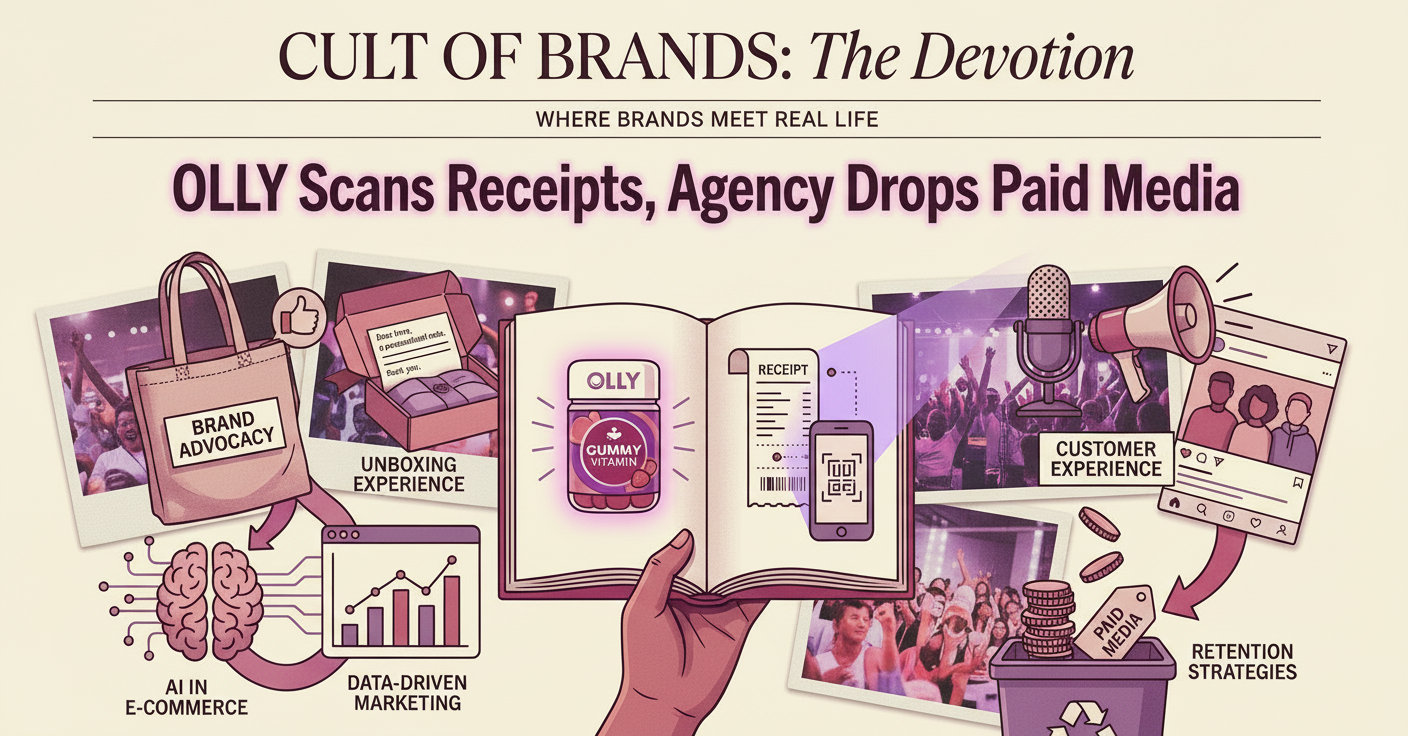
Take OLLY, for instance, a Unilever brand that sells everywhere from your local Target to their own DTC site. Jennifer Peters, Director of DTC, MarTech & Digital Compliance at OLLY, dropped a bomb that most CPG marketers would balk at: 80% of their revenue and customers are shopping in brick and mortar. So, how do they build that retention engine when they can't even get direct customer data? Receipt scanning. Yes, you read that right. They're asking people to scan their physical receipts into their loyalty program. That's not just "omnichannel thinking"; that's getting down and dirty to connect the dots in a truly fragmented customer journey. It’s expensive, it’s complex, but it’s how you build a real retention loop when your product lives as much on a retail shelf as it does in an online cart.
"Probably 80% of our revenue and customers are shopping in brick and mortar stores. What we've decided to do is to really leverage our loyalty program to try to capture that data." — Jennifer Peters, Director of DTC, MarTech & Digital Compliance at OLLY
And it's not just CPG. This week, I heard an agency, Praella Agency, openly state they dropped paid media altogether. Amer Grozdanic, their CEO, talked about how they were burning out on it, and instead built a thriving Shopify-focused agency by specializing in on-site conversion and leveraging Shopify's ecosystem. They focus on direct and organic traffic. This isn't just a pivot; it's a fundamental re-evaluation of where ROI truly lives for many brands right now. If an agency can thrive by ditching paid media, imagine what that means for your brand's balance sheet.
"Praella Agency, despite growing large brands, completely avoids paid media management due to past burnout and a focus on controllable marketing channels like direct and organic traffic." — Amer Grozdanic, CEO of Praella Agency
Then there's the nuanced discussion around discounting. Muhammed Tüfekyapan, Founder of Growth Suite, highlighted the revenue killer that is blind discounting. We're giving discounts to people who were going to buy anyway, eroding margins in an already cutthroat market. His solution? Using first-party Shopify data to identify "hesitant shoppers" and offering them a targeted, single-use, timed discount. This is smart retention, not just throwing money at a problem. It's about knowing your customer so intimately you can give them just enough nudge without leaving cash on the table.
"What we are doing is we are waiting until the customer is it think like they are not going to buy in that session. When we see that grocery starts to make something if it doesn't see that pattern, it just waits patiently." — Muhammed Tüfekyapan, Founder at Growth Suite
Lastly, John DiJulius, Founder and Chief Revolution Officer of The DiJulius Group, brought it all back to the human element of retention: customer experience (CX). He emphasized that world-class CX isn't about budget; it's about a systematic approach. His "10 Commandments of Customer Experience" highlight that consistency and specificity are paramount. You can't just tell employees to be "hospitable"; you need to define it, make it trainable, observable, and measurable. Technology enables, but the human touch differentiates.
"The number one CX problem is consistency — and the root cause is 100 different personal interpretations of what great service means." — John DiJulius, Founder and Chief Revolution Officer of The DiJulius Group
The takeaway? The game has changed. Acquisition is a battle of attrition. Retention, driven by deep customer understanding, intelligent use of data, and a relentless focus on CX, is where sustainable, profitable growth is built. This isn't just about email flows anymore; it's about fundamentally rethinking how you interact with your customer at every single touchpoint, online and off.
Ideas in Brief
Website Design Lessons from the Best (and the Sketchy): Nik Sharma, host of Limited Supply, broke down how brands like The Absorption Company, Pulsetto Tech, and Bioma Health are using subtle design elements and sophisticated sales funnels to drive conversion. He highlighted the importance of small UX details, like descriptive iconography increasing revenue per session, and how collection pages can function as educational landing pages. Nik also exposed potentially "false advertising" by Bioma Health with deceptive pricing, reminding us that while optimization is key, ethical practice is paramount. His analysis of psychological pricing (a mere $9 difference to upsell) and quiz-driven funnels shows how deeply brands are thinking about guiding customer choices.
"Building brand is a culmination of 100,000 things done at a very small level. Like doing things 1% better over time. Every day, all day, all the time, in every channel, at every touch point. That's how you build brand." — Nik Sharma, Host of Limited Supply
The "Profit Engineer" & Data Trust: Richard Gaffin and Luke Austin from Common Thread Collective identified the core problem for mid-market e-commerce brands ($20-100M): they don't trust their numbers. This leads to 80% of review meetings being spent on understanding "what's happening" rather than "what to do." Their solution is a new role, the "Profit Engineer," which consolidates growth strategy, creative, media measurement, and management into a single, high-capacity individual. This challenges the traditional distributed team model, suggesting that integrated, accountable intelligence is the fastest path from insight to action.
"The brands who sign with us don't sign because performance is down. They sign because they don't know why performance is happening." — Richard Gaffin, Director of Digital Product Strategy at Common Thread Collective
AI for Visuals is Beyond a Hack (It's a Game Changer): Monte Desai, Founder of Pixii.ai, highlighted how poor product listing design is costing brands massive sales. His AI tool, trained on 100,000 top Amazon listings, generates high-converting, editable images and full creative strategies in minutes. This isn't just a cost-saver on photoshoots (he cited one client saving $20K/month); it's about continuous optimization. With algorithms and consumer behavior constantly shifting, the ability to refresh visuals almost instantly, backing it with data, can drastically improve conversion rates and even reduce ad spend. This signals a future where creative iteration is as fast and data-driven as media buying.
"Most listings don't fail because of the product. They fail because of the design." — Claus Lauter, Host of Ecommerce Coffee Break – The Ecom Marketing & Sales Podcast
Your Site Search is Bleeding Cash: Paulius Nagys, Co-founder of LupaSearch, dropped a stat that should make every e-commerce operator wince: 80% of online shoppers abandon search when they can't find products, and 70% of e-commerce search tools fail on simple queries. Your customers have a "patience gap," not a product gap. His solution, LupaSearch, uses AI and vector search to match "meaning" instead of just keywords, drastically closing that gap. This is especially critical for brands with large, vertical catalogs (think DIY or pharmacuticals) where customers search by "symptom" rather than exact product names. Investing in intelligent site search isn't just a UX improvement; it's a direct revenue lever.
"According to Forrester, they say 80% of online shoppers abandon search when they can't find products. We found that customer gives only two to five chances before they bounce to competitor and we are calling it patient gap. So it's a silent revenue killer." — Paulius Nagys, Co-founder at LupaSearch
The Unsung Power of Brand Networks: Forget chasing mega-influencers whose audience metrics are more vanity than sales. Paul Archer and Verity Hurd, hosts of Building Brand Advocacy, argue for activating your actual "brand network"—customers, creators, and even employees—to drive authentic advocacy. They claim 93% of social views are non-follower views. This means that audience size is often irrelevant; what matters is the authenticity of the message and the willingness of real people to talk about your brand. So, stop throwing money at influencer trips and start building genuine communities. They even suggest that by 2026, the traditional "influence manager" role might disappear, automated by AI, making authentic advocacy even more critical.
"Often it's a lot cheaper to advertise to advocates to become an advocate than it is to advertise to customers to become a customer." — Paul Archer
The Convert: Beautyblender
Beautyblender is the ultimate lesson in building a brand when formal protection fails. Founder Rea Ann Silva revealed she couldn't secure a patent for her iconic sponge despite years of trying. This forced her to lean entirely on building an undeniable brand through professional artist networks and authentic storytelling. She didn't pay herself for eight years, bootstrapping a multi-million dollar business and even embracing "knockoffs" as validation for her category-founding product. It's a masterclass in how brand recognition, fueled by genuine relationships, can be more powerful than any legal document.
The Tension: AI as a Solution vs. AI as a Problem
This week saw a fascinating, albeit subtle, tension emerge around AI: is it primarily a solution to our problems, or is it, as Laura Cantor (VP of Marketing & E-commerce, New York & Company) put it, "both the creation of and solution to so many of our problems"?
On one hand, we heard glowing examples of AI as a problem-solver. Laura herself highlighted how an agentic AI QA tool (Zent AI) uncovered over 500 previously unseen micro-issues on a live website. This speaks to AI's ability to tackle complexity and scale diagnostics far beyond human capacity. Monte Desai discussed how Pixii.ai leverages AI to automate creative strategy and generate high-converting product visuals, solving the constant need for fresh, effective content. Paulius Nagys made a strong case for AI in site search with LupaSearch, arguing that it understands "meaning" to close the "patience gap" and prevent lost sales.
"AI is both the creation of and solution to so many of our problems. Because you went and used AI to Q&A 500 micro issues." — DTC Newsletter and Podcast, Host of DTC Newsletter and Podcast
Yet, there was an undercurrent of caution. Amer Grozdanic noted that while AI makes tasks like Shopify Flow generation easier, it also increases the need for expert troubleshooting when bugs inevitably occur. This suggests AI shifts the nature of problems rather than eliminating them. Paulius Nagys also offered a contrarian view, predicting that widespread adoption of advanced AI in e-commerce will take significantly longer than current expectations, cautioning against FOMO-driven investments.
"AI tools, despite making complex tasks like Shopify Flow generation easier, increase the need for expert troubleshooting when bugs occur, changing the agency role rather than eliminating it." — Amer Grozdanic, CEO of Praella Agency
The tension lies in striking the right balance. AI clearly offers immense potential for efficiency and insight, but operators are wisely recognizing that it's not a silver bullet. It requires human oversight, strategic integration, and an understanding that new problems will arise alongside the solutions it provides. The most successful brands won't just adopt AI; they'll thoughtfully deploy it as a tool within a larger, human-centric strategy.
Appendix
1. The Unofficial Shopify Podcast: "Why This Agency Dropped Paid Media (And Got Bigger)"
Guests: Kurt Elster (Host, The Unofficial Shopify Podcast), Amer Grozdanic (CEO, Praella Agency), Amer Grazdonic (Founder, Pralla)
Runtime: 77m | Vibe: The Unlikely Shopify Success Story
Key Signals:
- Paid Media Burnout & Pivot: Praella Agency, despite scaling large brands, completely eliminated paid media management due to past burnout, focusing instead on controllable marketing channels like direct and organic traffic. This allowed them to build a successful "on-site" Shopify agency, highlighting a contrarian, yet effective, path amidst escalating CAC.
- Shopify Exclusivity Advantage: The agency's decision to go all-in on Shopify significantly reduced project timelines and costs compared to platforms like Magento. This specialization led to more enjoyable and efficient client engagements, suggesting that deep expertise in one ecosystem can be a competitive differentiator.
- Underutilized Shopify Features & AI: The discussion highlighted the untapped potential of features like Shopify B2B, Markets for internationalization, and live video selling platforms like Whatnot (mentioned for its 10x higher conversion rate than TikTok Shop). It also touched on AI tools like Sidekick and the evolving role of agencies in an AI-driven world, where expert troubleshooting for AI-generated code becomes crucial.
"Launching on Shopify made everything more enjoyable. The bills were a lot quicker. The quotes were a lot of competitive. We used to go against Magento Agencies. Magento Agency would quote something for 80,000 on Shopify. We do it for 30, 40 in half the time." — Amer Grozdanic, CEO of Praella Agency
2. DTC Podcast: "Ep 586: Laura Cantor: Digital Transformation, AI Collaboration, and Why We're All Failing Calculus Together"
Guests: Laura Cantor (VP of Marketing & E-commerce, New York & Company), DTC Newsletter and Podcast (Host, DTC Newsletter), Eric Dick (Host, DTC Newsletter and Podcast)
Runtime: 52m | Vibe: Legacy Retail's Agile Leap
Key Signals:
- Headless Reversal for Agility: New York & Company pivoted from a Shopify Hydrogen headless setup back to traditional Liquid, prioritizing agility and simpler ecosystem integration over perceived headless benefits. This signals that complexity isn't always progress, especially for legacy brands.
- AI-Driven QA & Hidden Issues: The use of an agentic AI QA tool (Zent AI) uncovered over 500 previously unseen micro-issues on a live website, highlighting the limitations of manual QA and the potential for AI to dramatically improve site health even post-launch.
- Partnerships as Growth Strategy: In an era of reduced media spend, fostering strong, collaborative partnerships with vendors and technology providers has become critical for growth. Brands and partners are increasingly dependent on each other to navigate complex digital transformations.
"We're all failing the calculus class together. We are, this is AI. We are in one giant study group and it's not like we should or can necessarily hang out on our own island and think that we're going to conquer these massive undertakings and shifts in, in the way that we do business." — Laura Cantor, Guest on DTC Newsletter and Podcast
3. Shopify Masters: "The Problem Every Makeup Artist Faces And How I Turned It Into Millions"
Guests: Rea Ann Silva (Founder, Beautyblender), Adam Lavinter (Host, Shopify), Rhiannon (Founder, Beautyblender)
Runtime: 44m | Vibe: Bootstrapped Beauty Empire
Key Signals:
- Brand Over Patent: Despite failed attempts to patent her product, Beautyblender founder Rea Ann Silva built a multi-million dollar global brand by prioritizing brand recognition and authenticity. This demonstrates that a strong brand narrative can be a more powerful defense than IP protection, especially for self-funded startups.
- Bootstrapping & Passion: Silva famously didn't pay herself for the first eight years, a testament to extreme bootstrapping and genuine passion for solving a problem for makeup artists. This unwavering dedication fueled organic growth and network effects within the professional community.
- Competition as Validation: Rather than solely fighting "knockoffs," Beautyblender leveraged competition to further reinforce its unique story and category-creator status. This reframes competition as an opportunity for storytelling and market education.
"I was not awarded a patent on beautyblender. I tried for several years. I tried until I couldn't try anymore. And every time you are rejected, you have the opportunity to try again, but then the costs continue to increase." — Rea Ann Silva, Founder of Beautyblender
4. Ecommerce Playbook: Numbers, Struggles & Growth: "224 Calls Later… This One Problem Showed Up Everywhere"
Guests: Richard Gaffin (Director of Digital Product Strategy, Common Thread Collective), Luke Austin (VP of E-Commerce Strategy, Common Thread Collective), Richard (Host, Commenterko.com), Luke (Host, Commenterko.com)
Runtime: 31m | Vibe: Decoding Data Chaos
Key Signals:
- Mistrust of Numbers: The primary problem for mid-market e-commerce brands ($20-100M) is a lack of trust in their own data, leading to analytical paralysis. They hire for clarity, not just bad performance.
- Inefficient Review Meetings: 80% of business review meetings are spent trying to understand what's happening, leaving little time for actionable ideation. This highlights a critical workflow and data integrity issue.
- The "Profit Engineer" Model: Introduction of a new role that integrates growth strategy, creative strategy, media measurement, and management into a single high-capacity individual. This aims to streamline decision-making and accountability, challenging traditional multi-person workflows.
"The number one thing that brands kind of in this range, which I'm going to say is roughly, let's say 20 to 100 million... is that they don't trust their numbers." — Richard Gaffin, Director of Digital Product Strategy at Common Thread Collective
5. Ecommerce Coffee Break – The Ecom Marketing & Sales Podcast: "How to Turn Your Product Listing Into a Selling Machine — Monte Desai | Why Bad Designs Lose Sales, How AI Speeds Up Design, What Drives Higher Conversion Rates, Why Constant Listing Updates Matter, How AI Automates Creative Strategy (#464)"
Guests: Claus Lauter (Host, Ecommerce Coffee Break – The Ecom Marketing & Sales Podcast), Monte Desai (Founder, Pixii.ai)
Runtime: 21m | Vibe: Visual AI for Conversion
Key Signals:
- Design as Conversion Driver: Most product listings fail due to poor design, not the product itself. Improving visuals dramatically increases conversion rates (e.g., 3% to 4% conversion equals a 33% revenue increase) and reduces ad spend.
- AI for Visual Optimization:Pixii.ai, an AI tool, generates high-converting, editable images and full creative strategies in minutes, trained on top Amazon listings. This tool automates and scales visual optimization, saving significant costs on photoshoots.
- Constant Listing Refresh: Due to changing algorithms and consumer behavior, continuous refreshing of product listing visuals is crucial. AI enables rapid, data-backed iteration, which is a competitive advantage.
"Most listings don't fail because of the product. They fail because of the design." — Claus Lauter, Host of Ecommerce Coffee Break – The Ecom Marketing & Sales Podcast
6. Ecommerce Playbook: Numbers, Struggles & Growth: "How OLLY Built a Retention Engine for a Brand Sold Everywhere"
Guests: Taylor (Host, Common Thread Collective), Jennifer Peters (Director of DTC, MarTech & Digital Compliance at OLLY, OLLY (a Unilever brand)), Jennifer (Head of Marketing Technology, OLLY)
Runtime: 33m | Vibe: CPG Retention Unlocked
Key Signals:
- Retention Beyond Subscriptions:OLLY's retention strategy extends far beyond subscriptions, encompassing loyalty programs and referrals, highlighting a broader view of customer lifetime value.
- Omnichannel Data Collection: For CPG brands sold everywhere, collecting customer data from brick-and-mortar shoppers is a major challenge. OLLY addresses this by leveraging receipt scanning within its loyalty program, capturing data for 80% of its customers who shop in retail.
- Strategic AI Integration:OLLY uses AI for email and SMS segmentation to identify new customer demographics and optimize content, but emphasizes a human-centered, strategic approach to AI rather than reactive adoption.
"Probably 80% of our revenue and customers are shopping in brick and mortar stores. What we've decided to do is to really leverage our loyalty program to try to capture that data." — Jennifer Peters, Director of DTC, MarTech & Digital Compliance at OLLY
7. Building Brand Advocacy: "The 3‑Step Framework to Organic Brand Advocacy in 2026"
Guests: Paul Archer (Host), Verity Hurd (Host), Paul (Host, Building Brand Advocacy), Verity (Host, Building Brand Advocacy)
Runtime: 27m | Vibe: Authentic Advocacy Revolution
Key Signals:
- Influencer Marketing is Broken: The current model of influencer marketing, focused on audience size and one-off campaigns, is outdated. 93% of social views are non-follower views, making audience size an irrelevant metric.
- Organic Advocacy Engine: Brands should shift to fostering relationships with a network of authentic advocates (customers, creators, employees) rather than paying for reach. This includes mapping your brand network to identify "famous fans."
- "Real" Earned Media Value: A new metric, "gross advocacy value," combines revenue from commercial creators, earned media value, and inferred UGC value, providing a finance-grade ROI for advocacy. Employee advocacy is highlighted as an untapped, authentic marketing channel.
"Often it's a lot cheaper to advertise to advocates to become an advocate than it is to advertise to customers to become a customer." — Paul Archer
8. Ecommerce Coffee Break – The Ecom Marketing & Sales Podcast: "How To Turn Site Search Into A High-Performing Revenue Engine — Paulius Nagys | Why Complex Catalogs Need AI, Why Patience Gaps Kill Sales, How AI Matches Search Intent, Why Search Bars Provide Feedback, What Vector Search Actually Does (#463)"
Guests: Claus Lauter (Host, Ecommerce Coffee Break – The Ecom Marketing & Sales Podcast), Paulius Nagys (Co-founder, LupaSearch)
Runtime: 22m | Vibe: AI-Powered Search Genius
Key Signals:
- The "Patience Gap": 80% of online shoppers abandon search if they can't find products, and 70% of e-commerce search tools fail on simple queries. This "patience gap" is a silent revenue killer.
- AI for Intent Matching:LupaSearch uses AI and vector search to match "meaning" rather than just keywords, significantly improving product findability, especially for complex catalogs or "symptom searches" (e.g., DIY, home & garden).
- Search Bar as Feedback Channel: The search bar provides invaluable, real-time customer feedback, offering insights into customer behavior and unmet needs that brands often overlook.
"According to Forrester, they say 80% of online shoppers abandon search when they can't find products. We found that customer gives only two to five chances before they bounce to competitor and we are calling it patient gap. So it's a silent revenue killer." — Paulius Nagys, Co-founder at LupaSearch
9. eCommerce Fastlane: Shopify Growth Strategies—Where AI Efficiency Meets Human Connection: "Stop Giving Discounts To Customers Who Were Already Going To Buy"
Guests: Steven Hutt (Host, Founder, Strategic Advisor, eCommerce Fastlane), Muhammed Tüfekyapan (Founder, Growth Suite)
Runtime: 41m | Vibe: Smart Discounting Revenue Hack
Key Signals:
- Margin Erosion from Blind Discounting: Brands often give discounts to customers who would have purchased anyway, leading to unnecessary margin loss, especially problematic with high CAC.
- Targeted "Walk-Away" Offers:Growth Suite identifies "hesitant shoppers" using real-time first-party Shopify data and offers single-use, timed discounts only to those likely to abandon their cart. This prevents coupon leakage and maximizes conversion at optimal margin.
- Deep Shopify Integration:Growth Suite works directly on the Shopify site, using its own database to avoid inconsistencies from third-party data, providing immediate value within the first day of installation.
"What we are doing is we are waiting until the customer is it think like they are not going to buy in that session. When we see that grocery starts to make something if it doesn't see that pattern, it just waits patiently." — Muhammed Tüfekyapan, Founder at Growth Suite
10. Limited Supply: "S15 E7: More Website Design Lessons From the Best Brands"
Guests: Nik Sharma (Host, Limited Supply)
Runtime: 47m | Vibe: Website Conversion Teardown
Key Signals:
- Small UX Details, Big Impact: Nik Sharma emphasizes that brand building is a "culmination of 100,000 things done at a very small level." Highly descriptive iconography, even for seemingly minor elements, can directly increase revenue per session by improving user comprehension.
- Collection Pages as Landing Pages: Successful brands treat collection pages as educational landing pages, not just product listings. Optimizing these with proper H1s, subheadings, and backlinks significantly boosts SEO and conversion.
- Psychological Pricing & Quiz Funnels: Brands use subtle psychological cues, like minimal price differences between tiers, to upsell. Interactive, quiz-driven sales funnels (e.g., Bioma Health) provide personalized recommendations and education, mimicking a personalized consultation to optimize conversions.
"Building brand is a culmination of 100,000 things done at a very small level. Like doing things 1% better over time. Every day, all day, all the time, in every channel, at every touch point. That's how you build brand." — Nik Sharma, Host of Limited Supply
11. Customer Service Revolution: "241: CX Strategy Blueprint Part 1: The Proven Framework That Chick-fil-A, Starbucks & Ritz-Carlton Use to Dominate Customer Experience"
Guests: John DiJulius (Founder and Chief Revolution Officer, The DiJulius Group)
Runtime: 42m | Vibe: CX Mastering for Loyalty
Key Signals:
- Systematic CX, Not Luck: World-class customer experience is a systematic methodology, not reliant on budget or luck. Brands like Chick-fil-A demonstrate that a codified framework, like the "10 Commandments of Customer Experience," drives consistent, exceptional service.
- Consistency Through Definition: The core CX problem is inconsistency, stemming from varying employee interpretations of "great service." Leaders need to precisely define, make trainable, observable, and measurable what great service means.
- Signature Experience Differentiates: Technology only keeps brands at pace; a unique "signature experience" is what makes price irrelevant and truly differentiates a company. This requires meticulous journey mapping and operationalizing "above and beyond" moments.
"The number one CX problem is consistency — and the root cause is 100 different personal interpretations of what great service means." — John DiJulius, Founder and Chief Revolution Officer of The DiJulius Group
12. The Modern Customer Podcast: "Powering Connected Customer Conversations with Agentic Voice AI"
Guests: Ali Tore (SVP & GM of Conversational AI, RingCentral), Blake Morgan (Host, The Modern Customer Podcast)
Runtime: 31m | Vibe: The Future of Customer Conversations
Key Signals:
- Beyond Efficiency to Experience: Agentic AI should be viewed not just as an efficiency play, but as a tool to elevate the overall customer experience. Companies often prioritize automation metrics over actual customer outcomes, leading to fragmented experiences.
- Contextual AI for Customer Service:RingCentral's AI solutions (e.g., AI Receptionist, AI Conversation Expert) aim to provide context and coordinate actions across customer interactions, transforming AI from simple automation to a proactive decision-making assistant.
- Human Agents for Value: AI's role is to automate low-value tasks, freeing human agents to focus on complex problem-solving and empathetic, high-value interactions. This highlights a shift towards a hybrid model where AI supports, rather than replaces, nuanced human connection.
"Every company wants to be customer centric. But customers don't feel your intentions, they feel your systems." — Ali Tore, SVP & GM of Conversational AI at RingCentral