
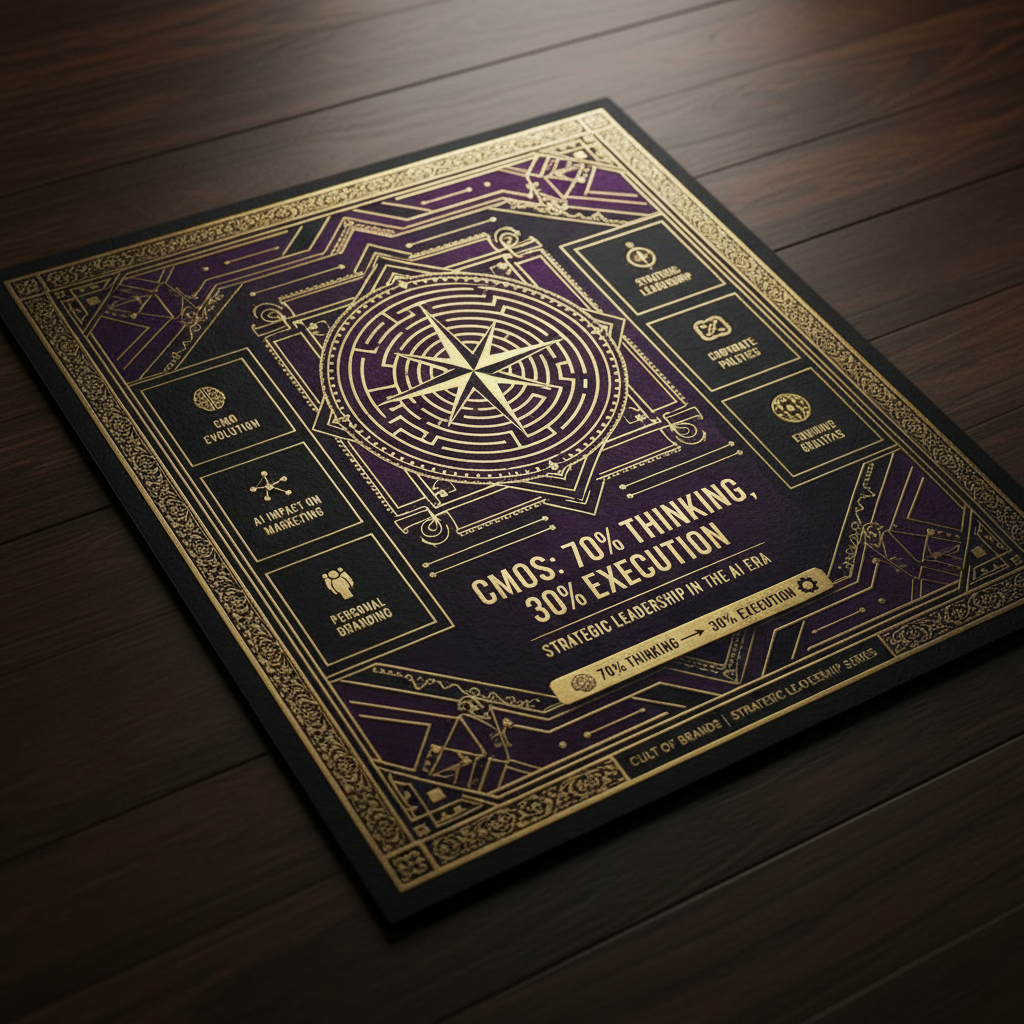
The CMO role is rapidly bifurcating: strategic orchestrators are ascending, while mere channel specialists are being hollowed out by AI.
The Intake
📊 8 episodes across 7 podcasts
⏱ 284 minutes of intelligence analyzed
🎙 Featuring: Jon Evans (Uncensored CMO), Walter Susini (Coca-Cola Europe), Jenny Rooney (Adweek), Alex Gonzalez (Metro Atlanta Chamber)
One Big Thing
The role of the Chief Marketing Officer is undergoing a profound and accelerating transformation. No longer is it sufficient to be merely a "brand person" or a "demand gen specialist." CEOs are increasingly demanding CMOs who act as general managers, capable of orchestrating growth across the entire business by leveraging technology, fostering talent, and navigating complex corporate dynamics. This shift highlights a departure from traditional marketing silos towards a more integrated, financially astute, and strategically agile leadership profile.
Why it matters: The accelerating pace of AI adoption amplifies this change, automating production and execution tasks, thus freeing CMOs to become system-level thinkers. Cameron Partridge, Chief Growth Officer at Human Force, notes that "Gen AI has made marketing much easier to produce, but conversely made it much harder to win." This paradoxical effect elevates the importance of strategic thinking over tactical execution, pushing marketers to focus on fundamentals like consistency, trust, and a multifaceted approach rather than getting lost in channel-specific obsessions. Marketers must now spend 70% of their time thinking and 30% on execution, a complete flip from traditional models.
Erica Seidel, Founder and Executive Recruiter at The Connective Good, observes a direct correlation in hiring trends, stating, "I want an orchestrator. I want a growth partner. I want somebody to uplevel the function. The person could come from anywhere. Which is a little bit different than what sometimes people say, which is like, oh, it's all about demand." This indicates a CEO-level expectation for CMOs to think beyond marketing and integrate deeply into the business's overall growth trajectory.
"I think typical marketing teams have done 70% production and execution, 30% thinking. I think this is a real opportunity to really flip that to be 70% thinking, 30% execution and production."
— Cameron Partridge, Chief Growth Officer at Human Force on The CMO Show
The broader implication: Success for future CMOs hinges not just on marketing acumen but on adaptability, leadership, and a deep understanding of business financials and operations. Walter Susini, Former CMO of Coca-Cola Europe, emphasizes that "Marketing is a discipline, not a function." This reinforces the need for CMOs to embed marketing principles across the organization, influencing strategy, innovation, and even corporate politics. The pressure mounts on individuals at all levels of the marketing organization to either evolve into these strategic orchestrators or face the hollowing out of specialized roles susceptible to AI automation.
The Rundown
① Boards are now leveraging CMO advisory councils for economic development and civic branding.
Alex Gonzalez, Chief Innovation and Marketing Officer at Metro Atlanta Chamber, highlighted how Atlanta leverages an advisory council of CMOs to attract talent and businesses for its "Atlanta, where you belong" initiative. (Alex Gonzalez on Marketing Vanguard)
→ Strategic Advantage: CMOs who can demonstrate their ability to go beyond product marketing and contribute to broader economic or civic initiatives can significantly elevate their strategic value to executive leadership and boards.
② The traditional lines between internal strategy and external brand perception are dissolving, demanding a new kind of "System 3" AI-augmented thinking.
Adam Ferrier, Founder of Thinkerbell, discussed the concept of "System 3" where AI acts as an external cognitive partner, influencing human decision-making and brand interactions, bridging an internal human process with external AI input. (Adam Ferrier on The WARC Podcast)
→ CMO Action Point: CMOs must develop strategies for their brands to engage with AI as a cognitive partner, ensuring brand narratives are clear enough to inform LLMs and protect against the homogenizing effects of AI.
③ A strong personal brand is becoming a critical "insurance policy" for CMOs in volatile markets.
Vanessa Errecarte, CEO of Marketing Simplified &MBA Educator at UC Davis Graduate School of Management, articulated that a personal brand provides a portable hedge against job market volatility, offering security beyond specific roles. (Vanessa Errecarte on On Brand with Nick Westergaard)
→ Personal Strategy: CMOs should cultivate a personal brand that demonstrates unique perspective and impact, reframing self-promotion as a service-first act that builds credibility and career resilience.
④ Decisions at the executive level are rarely made in formal settings, underscoring the importance of understanding informal power dynamics.
Walter Susini, Former CMO of Coca-Cola Europe, revealed that most critical corporate decisions occur outside of official meetings, necessitating a deep understanding of "performance theater" and "Game of Thrones" dynamics within corporations. (Walter Susini on Uncensored CMO)
→ Leadership Insight: CMOs must hone their political intelligence to navigate organizational power structures effectively, influencing outcomes by understanding the hidden channels and informal processes where true decisions are forged.
⑤ CEOs are seeking "growth partners" who can "orchestrate" value across the business, not just manage marketing channels.
Erica Seidel, Founder and Executive Recruiter at The Connective Good, emphasized that the new CMO mandate transcends traditional marketing roles, prioritizing holistic growth and leadership. (Erica Seidel on Renegade Marketers Unite)
→ Career Direction: Aspiring and current CMOs should reframe their career narratives and skill development to emphasize cross-functional leadership, financial acumen, and the ability to drive enterprise-wide growth initiatives.
Signal Board
🔥 HEATING UP
• CMO as Growth Partner: The expectation for CMOs to be orchestrators of overall business growth, moving beyond siloed marketing functions. (Erica Seidel on Renegade Marketers Unite)
• Origin Stories: The power of foundational brand narratives to drive innovation and differentiate, serving as distinctive assets. (David Aaker on Sleeping Barber - A Marketing Podcast)
• Corporate Political Intelligence: The crucial ability to navigate informal power dynamics and "performance theater" in corporate environments for C-suite effectiveness. (Walter Susini on Uncensored CMO)
🔭 ON WATCH
• System 3 Thinking (Artificial Cognition): The emerging concept of AI as an external cognitive partner in human decision-making, revolutionizing consumer behavior. (Adam Ferrier on The WARC Podcast)
• AI-Driven Shift in Marketing Roles: The displacement of channel specialists and junior marketers by AI, leading to a 'hollowed-out middle' and emphasis on generalist strategic roles. (Cameron Partridge on The CMO Show)
• Personal Branding for Resilience: The growing recognition that a strong, service-first personal brand acts as a crucial "insurance policy" in a volatile job market. (Vanessa Errecarte on On Brand with Nick Westergaard)
❄️ COOLING OFF
• Short-termism in Marketing: While often seen as a modern problem, this is a cyclical issue and was more pronounced in the 1980s, suggesting it's less a new trend and more a recurring challenge. (Marc on Sleeping Barber - A Marketing Podcast)
• Corporate Psychological Safety & Vulnerability: These concepts are treated as less relevant in the "Game of Thrones" reality of corporate politics where perception often trumps authenticity. (Walter Susini on Uncensored CMO)
The Bottom Line
CMOs must evolve from campaign managers to strategic orchestrators, fusing business acumen with AI literacy, or risk irrelevance in a rapidly transforming corporate landscape.
Your Move
• Re-evaluate Talent Structure: Assess whether your marketing team is optimized for strategic thinking and system-level orchestration, rather than channel-specific execution, given AI's increasing capabilities (Cameron Partridge on The CMO Show).
• Map Executive Political Landscapes: Identify the true decision-makers and informal channels of influence within your organization to ensure your initiatives gain traction beyond formal meetings (Walter Susini on Uncensored CMO).
• Audit Brand Governance for AI: Develop clear guidelines and proprietary assets to inform LLMs and protect your brand's uniqueness from the homogenizing force of generative AI (Adam Ferrier on The WARC Podcast).
• Formalize Personal Brand Strategy: Dedicate time to cultivate your personal brand as a service-first leader, recognizing its increasing importance as a career hedge and credibility builder in a volatile market (Vanessa Errecarte on On Brand with Nick Westergaard).
• Integrate Marketing into Economic Development: Explore how your marketing expertise can contribute to broader organizational or regional economic development goals, elevating your strategic influence beyond traditional marketing (Alex Gonzalez on Marketing Vanguard).
Toolkit
The "CEO's CMO" Readiness Checklist (Inspired by Erica Seidel on Renegade Marketers Unite)
Are you positioning yourself as the 'orchestrator' and 'growth partner' CEOs are now demanding? Use these questions to evaluate your readiness for your next executive committee meeting, board presentation, or strategic offsite:
- Growth Partner Mindset: Can you articulate your marketing strategy's direct impact on the company's P&L and enterprise value, speaking the language of the CFO and CEO?
- Cross-Functional Orchestration: Do you have tangible examples of leading initiatives that required collaboration across multiple departments (e.g., product, sales, finance) to achieve a unified business objective?
- Talent Development & System-level Thinking: Have you restructured your team or initiated training programs to pivot from channel specialization towards broader strategic thinking and oversight of AI-driven workflows?
- Political Acumen: Do you actively map informal decision-making networks and deploy influence strategies to advance key initiatives, rather than relying solely on formal processes?
- Visionary Leadership: Can you clearly articulate how marketing will adapt to and leverage emerging technologies like AI, not just for efficiency, but for strategic advantage and competitive differentiation?
A "yes" to these questions demonstrates you are not just a marketing leader, but a business leader ready to transcend the CMO role.
📖 Want the full episode breakdowns, guest details, and listen links?
Quick Appendix
Marketing Vanguard: "How Atlanta Became the Hub of Marketing in the US ft. Alex Gonzalez" · 20 min · Featuring Jenny Rooney, Alex Gonzalez
For the Strategic Leader: An excellent case study on how cities are leveraging CMO expertise for economic development and place branding, demonstrating marketing's impact beyond commercial products. ▶ Listen
Uncensored CMO: "The price of leadership: the sacrifices every CMO has to make" · 19 min · Featuring Kory Marchisotto, Jon Evans
For the Aspiring CMO: A candid look at the personal demands of top-tier marketing leadership, offering insights into managing work-life balance and the reality of global travel. ▶ Listen
Sleeping Barber - A Marketing Podcast: "SBP 187: The PostPod - Lessons from David Aaker: The Power of Origin Stories" · 25 min · Featuring Marc, Vassilis, David Aaker
For the Brand Strategist: Essential listening for understanding how origin stories and brand differentiation drive market share, challenging short-termism with a historical perspective. ▶ Listen
The CMO Show: "How to stay sane in the AI chaos with Cameron Partridge" · 34 min · Featuring Mark Jones, Cameron Partridge
For the Forward-Thinking Executive: A critical discussion on AI's bifurcation of marketing roles, emphasizing the need for strategic thinking over execution and a return to fundamentals. ▶ Listen
Renegade Marketers Unite: "512: Finding and Winning Your Next CMO Role" · 48 min · Featuring Erica Seidel, Drew Neisser
For the CMO in Transition: Crucial guidance on navigating the evolving CMO hiring landscape, focusing on the CEO-CMO relationship and strategic career storytelling. ▶ Listen
The WARC Podcast: "Here comes System 3: a theory of artificial cognition" · 45 min · Featuring Lena Roland, Adam Ferrier
For the Innovation Lead: A deep dive into "System 3" AI theory, offering actionable strategies for brands to build fame and manage intellectual property in an AI-augmented world. ▶ Listen
On Brand with Nick Westergaard: "The Cringe-Free Guide to Personal Branding" · 32 min · Featuring Nick Westergaard, Vanessa Errecarte
For the Executive Personal Brand Builder: A refreshing perspective on personal branding, reframing it as a service-first act that builds portable career insurance in volatile markets. ▶ Listen
Uncensored CMO: "Coke CMO’s lessons on advertising, innovation and surviving corporate politics - Walter Susini" · 61 min · Featuring Walter Susini, Jon Evans
For the C-suite Navigator: Unfiltered advice on corporate politics, innovation, and utilizing distinctive assets, vital for thriving in complex organizational environments. ▶ Listen