
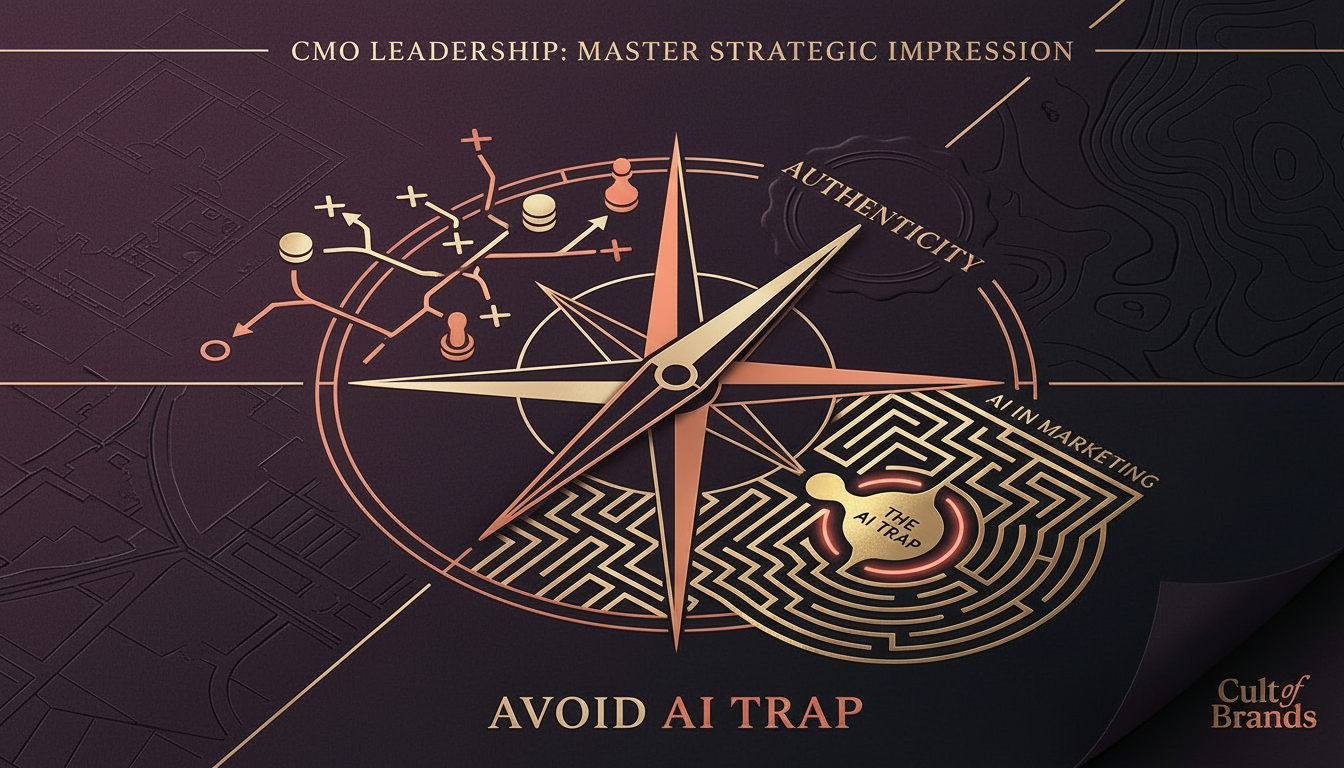
The strategic CMO today navigates a landscape where authenticity is a performance, metrics are landmines, and AI demands business leadership, not just technical adoption.
The Intake
📊 10 episodes across 8 podcasts
⏱ 339 minutes of intelligence analyzed
🎙 Featuring: Nick Westergaard, Tomas Chamorro-Premuzic, Sleeping Barber, Jim Stengel
One Big Thing
The Authenticity Trap: Why Strategic Impression Management Trumps Raw Transparency
The conventional wisdom of "just be yourself" is not only bad career advice but fundamentally misunderstands the role of emotional intelligence in leadership and branding. This week, conversations across multiple podcasts converged on a nuanced view of authenticity, revealing that the most effective leaders and brands don't simply "be themselves," but rather master strategic impression management.
Tomas Chamorro-Premuzic, Chief Innovation Officer at ManpowerGroup, challenged the notion directly on On Brand with Nick Westergaard, arguing that "emotional intelligence... is the ability to not just leak all your emotions in a genuine way, but to strategically manage what you convey and what you don't." He suggests that perceived authenticity is often the result of meticulous "choreographing [of one's] professional reputation." This isn't about deception, but about intentionality – choosing how and when to reveal aspects of oneself or a brand to achieve specific strategic outcomes.
This insight extends beyond personal branding to corporate strategy. For instance, Conny Kalcher (Global Chief Customer Officer, Zurich Insurance Group) on The CMO Podcast, detailed Zurich's transformation from a "cold and distant" brand to one focused on empathy. This wasn't a sudden, raw outpouring of corporate emotion, but a deliberate, data-driven initiative to redefine purpose and implement customer experience standards. The empathy, in this case, was a strategic choice, not an uncalculated display.
Why this matters for CMOs:
The proliferation of AI further complicates the landscape of authenticity. As Chamorro-Premuzic noted, "40 or 50% of what people are listening to are artists that don't exist," forcing a re-evaluation of what 'authentically human' even means. In an age where machines can replicate human interaction, the ability to consciously curate genuine connection, rather than simply presenting an unfiltered self, becomes paramount. CMOs must recognize that brand authenticity is not a passive state but an active, disciplined, and strategic endeavor. It requires understanding your audience, defining your desired perception, and then methodically building and communicating that narrative, much like a method actor honing a performance.
"Some of the people who are deemed the most authentic leaders or the most authentic people in the world, actually, they are like method actors. They have spent so much time choreographing their professional reputation that they seem real."
— Tomas Chamorro-Premuzic, Chief Innovation Officer at ManpowerGroup on On Brand with Nick Westergaard
The Rundown
① Goodhart's Law Is Wreaking Havoc on Marketing Incentives. When a measure becomes a target, it ceases to be a good measure, leading to perverse outcomes where optimizing for short-term metrics like CTR or MQLs damages long-term brand health. (Sleeping Barber - A Marketing Podcast on Sleeping Barber - A Marketing Podcast)
→ The Implication for CMOs: Audit your primary KPIs to identify incentive effects; if your team is rewarded solely on volume, it will inevitably cannibalize quality and long-term value.
② CMOs Must Speak the Language of Capital Allocation, Not Just Campaigns. To gain credibility with finance and the C-suite, marketers must shift discussions from vanity metrics to finance-centric concepts like ROI, discounted cash flow, and risk management. (Michael Kaminsky on That's What I Call Marketing)
→ The Implication for CMOs: Learn the CFO's lexicon and be willing to admit when campaigns underperform, building trust through transparent, incrementality-focused experimentation over "false precision."
③ B2B Marketers are Sitting on a $1.9 Trillion Hidden Brand Value Opportunity. Despite a historical focus on "marcom" and a prevalent "fear of failure" among B2B buyers, there's significant untapped brand value waiting to be unlocked by confident B2B marketers who shift from attribution to contribution models. (Bill Zengel on CMO Confidential)
→ The Implication for CMOs: Lead the charge in B2B brand building by connecting marketing efforts to commercial contribution and addressing the emotional drivers (like fear) that hinder purchasing decisions.
④ AI Agents are the New Website Visitors, Demanding "Answer Engine Optimization". As AI replaces traditional search, brand visibility now hinges on optimizing content for AI agents, requiring structurally clear, credible, and consistent information that LLMs can easily summarize. (Marc on Sleeping Barber - A Marketing Podcast)
→ The Implication for CMOs: Reorient your content strategy beyond keywords to "answer engine optimization" (AEO), ensuring your brand story is digestible and trustworthy for AI, not just humans.
⑤ Positioning for Growth Requires CEO Buy-in and Problem-Centric Messaging. Many companies fail because their positioning is product-centric, lacks internal alignment, and doesn't own a specific problem that buyers deeply care about; the CEO must be in the room to redefine "why you matter" to the customer. (Bob Wright on Renegade Marketers Unite)
→ The Implication for CMOs: Secure CEO partnership for any major repositioning effort and ensure your brand's narrative focuses on solving pressing customer problems, rather than merely touting product features.
⑥ The "Connected Consumer" Is Defined by Behaviors and Communities, Not Age Demographics. Traditional age-based targeting is increasingly outdated; consumers are more unified by shared behaviors, interests, and participation in communities, especially within the creator economy. (Alex Brownsell on The WARC Podcast)
→ The Implication for CMOs: Shift audience segmentation models to prioritize behavioral and community allegiances over demographic buckets, informing more precise and effective media and content strategies.
Signal Board
🔥 Heating Up
• Empathy as a Strategic Advantage: Zurich Insurance's transformation proves empathy is a measurable driver of customer acquisition and brand value, challenging the perception of it as a mere soft skill. (Conny Kalcher on The CMO Podcast)
• CMOs leading AI strategy: CMOs are now seen as uniquely positioned to drive AI adoption for business outcomes, moving beyond just marketing applications. (Karin Timpone on Marketing Vanguard)
• Sports content surge on streaming platforms: Nielsen data shows a 52% increase in sports content consumption on major subscription platforms, indicating a significant ad revenue opportunity. (Marc on Sleeping Barber - A Marketing Podcast)
👀 On Watch
• Microdramas: Short, 90-second mobile-first episodes, primarily from Asia, are a rapidly growing content segment (projected $11 billion in 2025) that marketers should heed. (Maria Rue Goete on The WARC Podcast)
• AI-driven Answer Engine Optimization (AEO): The shift from SEO to AEO means content strategy must now optimize for AI agents that summarize and answer queries, not just keywords. (Marc on Sleeping Barber - A Marketing Podcast)
• Netflix ad tier: Netflix's ad business is projected to exceed $8 billion by 2030, leveraging identity-driven fandom to carve out significant CTV ad market share. (Celeste Huang on The WARC Podcast)
🥶 Cooling Off
• CTR correlation with brand awareness: Nielsen meta-analysis and Facebook's own research show less than 1% correlation between click-through rates and actual brand metrics or ROI. (Sleeping Barber - A Marketing Podcast on Sleeping Barber - A Marketing Podcast)
• Short-term ROAS trap: Over-optimizing for short-term return on ad spend often leads to long-term brand decline and business harm due to misaligned incentives. (Sleeping Barber - A Marketing Podcast on Sleeping Barber - A Marketing Podcast)
• Last-click attribution problem: Reliance on last-touch attribution for forecasting leads to unrealistic expectations and hinders understanding of true marketing incrementality. (Michael Kaminsky on That's What I Call Marketing)
The Bottom Line
In a world of increasing complexity and AI-driven abstraction, the CMO who understands the underlying mechanics of business value, psychological drivers, and strategic impression management will define the next era of growth.
Your Move
Here are three immediate actions for any CMO looking to elevate their function:
- Schedule a "Goodhart's Law" Audit: Convene your marketing leadership to critically review all current KPIs. Identify any metric that has become a target and assess its unintended consequences on long-term brand health or customer experience. Adjust incentives accordingly.
- Host a "CFO Language Immersion" Session: Organize an internal workshop with your team, potentially inviting a finance leader, to dissect financial statements relevant to your business and practice articulating marketing impact in terms of capital allocation, contribution margin, and enterprise value.
- Initiate an "AI Agent Readiness" Assessment: Task your digital and content teams to evaluate how your brand's digital assets (website, knowledge base, social profiles) are structured and optimized for AI agent consumption. Prioritize clarity, authority, and structural integrity for "answer engine optimization."
Toolkit
The "CEO Positioning Mandate" Diagnostic
This framework, inspired by thoughts from Bob Wright of Firebrick Consulting on Renegade Marketers Unite, empowers CMOs to diagnose the readiness of their organization for effective strategic positioning:
- Is the CEO in the Room? A positioning project without direct, active CEO involvement and buy-in is almost guaranteed to fail. Is your CEO fully committed and engaged in defining "why we matter"?
- Are We Product-Centric or Problem-Centric? Do your internal and external communications primarily focus on product features and functions, or do they deeply articulate the specific problems you solve for your target market?
- What "Problem" Do We Own? Can your organization clearly articulate a specific, meaningful problem that your target audience cares about, which you are uniquely positioned to solve?
- What's Our Biggest Competitor? Is it another company, or is it the "do nothing" status quo of your potential customers? Effective positioning must overcome customer inertia.
- Do We Equate Branding with Positioning? Understand that while branding is corporate identity and experience, positioning is a revenue-driving strategy focused on how you win in the market and should be revisited more frequently than branding.
📖 Want the full episode breakdowns, guest details, and listen links?
📖 Want the full episode breakdowns, guest details, and listen links?
Quick Appendix
On Brand with Nick Westergaard: "Being Yourself Is Bad Advice" · 33 min · Featuring Tomas Chamorro-Premuzic ▶ Listen
Sleeping Barber - A Marketing Podcast: "SBP 177: The Sharp Cut - The Incentives Trap: When Metrics Become Targets [Part 1]" · 23 min · Featuring Sleeping Barber ▶ Listen
That's What I Call Marketing: "S5Ep7: What your CFO actually wants to hear from you" · 35 min · Featuring Michael Kaminsky ▶ Listen
CMO Confidential: "Bill Zengel | ANA | The Confident B2B Marketer - Are You One of the Few?" · 36 min · Featuring Bill Zengel ▶ Listen
The CMO Podcast: "Conny Kalcher (Zurich Insurance) | Reinventing Insurance Through Empathy" · 60 min · Featuring Conny Kalcher ▶ Listen
Marketing Vanguard: "Successfully Using AI in Business with ClearPrompt CEO, Karin Timpone, at the World Economic Forum Event" · 18 min · Featuring Karin Timpone ▶ Listen
Sleeping Barber - A Marketing Podcast: "SBP 176: The Barber's Brief - Welcome to the Age of Answers" · 30 min · Featuring Marc ▶ Listen
Renegade Marketers Unite: "506: Positioning as a Growth Lever" · 51 min · Featuring Bob Wright ▶ Listen
The WARC Podcast: "The evolution of media's connected consumer" · 27 min · Featuring Alex Brownsell ▶ Listen
The WARC Podcast: "How Netflix became an advertising behemoth" · 26 min · Featuring Alex Brownsell ▶ Listen
