
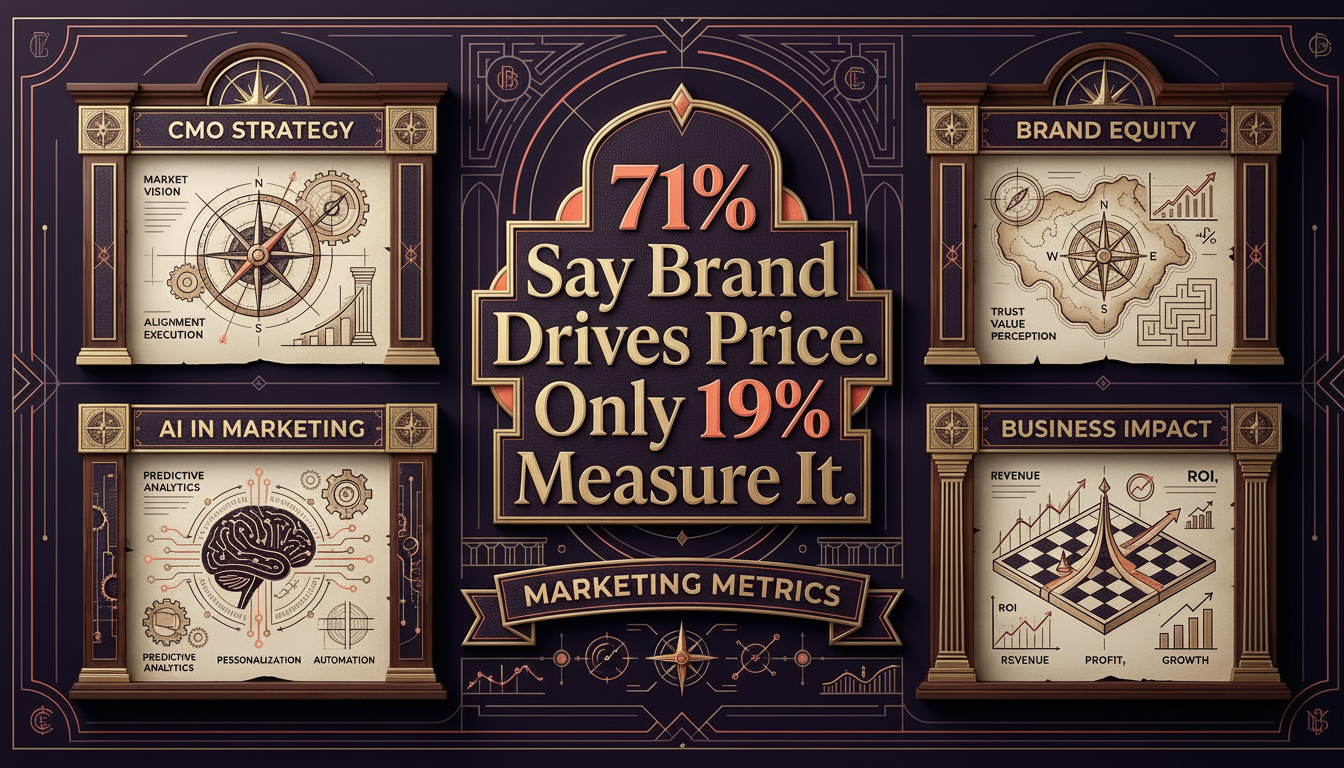
Tomorrow's leading CMOs won't just execute campaigns; they'll architect growth. Their tools: AI as a strategic partner and the ability to translate brand equity into financial metrics the boardroom understands.
The Intake
📊 7 episodes across 7 podcasts
⏱ 249 minutes of intelligence analyzed
🎙 Featuring: Ann Marie Kerwin, Stephanie Fierman, David Tiltman, Scott Woodward, Kory Marchisotto, Jon Evans, Laura Lynch, Nick Westergaard, Lauren Weinberg, Geoff Woods, Drew Neisser, Marc Binkley, Vassilis Douros
|

One Big Thing
The role of the strategic CMO is changing. Future leaders will be defined not by tactical skill, but by their ability to architect durable growth using a sophisticated understanding of brand equity and AI. This requires navigating the difficult space between short-term performance and long-term value, often against a corporate tide of skepticism and the demand for instant results.
The Core Challenge: Everyone says they believe in brand building, yet marketers keep shifting investments to short-term, measurable ad formats. It’s a classic “say-do gap” that creates a “doom loop” of optimizing against partial metrics that hide the real business impact.
The Boardroom Imperative: Stephanie Fierman, EVP, Head of Brand Practice at the ANA, shared survey data showing that “For 71% of our respondents, proving that brand allows you to charge more is a winning argument.” And yet, only 19% of marketers say the C-suite regularly credits shifts in brand equity with driving hard business outcomes (Stephanie Fierman on The WARC Podcast). This is a failure to translate marketing’s strategic contribution into the financial language of the business.
"The cause of a doom loop is optimizing your marketing spend against faulty or only partial metrics."
— David Tiltman, Head of Content at WARC on The WARC Podcast
AI as a Strategic Partner: Geoff Woods, author of *The AI-Driven Leader*, argues that executives should use AI as a strategic thought partner, not an oracle. Use it to ask probing questions that elevate leadership thinking. He suggests a “20% rule”: focus AI on high-impact use cases that create better leaders—who build better businesses—rather than just automating low-value tasks (Geoff Woods on Renegade Marketers Unite). This view of AI extends beyond marketing to reshape entire organizations and foster an “AI-driven leader” mindset.
The Synthesis: Sustaining growth requires navigating this complexity. Kory Marchisotto is President of e.l.f. Brands, a company that just saw 28 consecutive quarters of growth. She noted, "I can't study the competition because we're in a league of our own now at the type of growth that we're able to deliver. One of the things that's really important is to recognize that your greatest competition is the greatest version of yourself" (Kory Marchisotto on Uncensored Renegades). That mindset—plus the ability to articulate brand’s financial power and harness AI—is what will define the next generation of marketing leadership.
The Rundown
① Human Connection Is the Unpredictable Moat in an AI World.
As AI commodifies content creation and personalization, the most underestimated trend is a return to fundamental human connection and authentic brand storytelling. (Lauren Weinberg on Marketing Vanguard)
→ The Implication for CMOs: Let your creative teams focus on genuine narratives and community. Use AI for efficiency, but prioritize humanity for distinction. Competitive moats are shifting from technology to connection.
② Breakthrough Creative Often Begins as "Irrational," Unfit for Traditional Metrics.
Modern marketing’s focus on "defensibility over originality" and its over-reliance on pre-testing is producing a "sea of sameness." It kills breakthrough ideas that seem illogical at first but would have resonated with consumers. (Vassilis Douros on Sleeping Barber - A Marketing Podcast)
→ The Implication for CMOs: Bring back "creative risk budgets." Give agencies the freedom to develop campaigns that challenge immediate quantitative validation. Impact often arrives before conventional measurement can explain it.
③ CMOs Must Cultivate "P&L Sensibility," Even Without Direct Ownership.
CMOs need a deep understanding of how marketing budgets fit into the company’s overall P&L, even without directly owning it. This is critical for staying relevant and influential in the C-suite. (Lauren Weinberg on Marketing Vanguard)
→ The Implication for CMOs: Proactively translate marketing investments into the language of enterprise value. To keep your seat at the table, show clear connections between your strategy and the company's financial health.
④ Kindness Is a High-Leverage Strategic Advantage, Not a Soft Concept.
Research shows 61% of consumers avoid brands they see as unkind. And internal kindness boosts team creativity by 60%. This makes kindness a core strength for both leadership and brand appeal. (Scott Woodward on On Brand with Nick Westergaard)
→ The Implication for CMOs: Make kindness a deliberate brand value and operational principle—both in customer interactions and internal team culture. It will enhance loyalty and unlock innovation.
⑤ Sustaining Growth Requires Relentless Self-Reflection and Embracing Friction.
Achieving a rare feat like 28 consecutive quarters of growth requires persistence, self-reflection, and confronting reality. You have to recognize that "friction and tension is actually where the magic happens." (Kory Marchisotto on Uncensored Renegades)
→ The Implication for CMOs: Build a culture that actively seeks out and learns from feedback and internal disagreements. View these challenges as catalysts for growth, not obstacles. It’s how you build a durable advantage.
Signal Board
🔥 HEATING UP
• The Multiplier Effect: Strong brand equity doesn’t just build loyalty; it significantly enhances performance advertising ROI, proving integrated strategies drive impact. (David Tiltman on The WARC Podcast)
• Brand Authenticity & Heritage: Brands that root their identity in their heritage while still daring to compete globally are building stronger connections with both colleagues and customers. (Laura Lynch on That's What I Call Marketing)
• AI-Driven Leader: A new leadership paradigm is here. Executives are using AI not just as a tool, but as a strategic co-pilot to elevate their thinking and challenge assumptions. (Geoff Woods on Renegade Marketers Unite)
👀 ON WATCH
• "Right With You" platform: Bank of Ireland's new brand strategy, developed with deep employee and customer collaboration, is balancing ambition with authenticity to aim for global best-in-class status. (Laura Lynch on That's What I Call Marketing)
• CRIT Framework (Context, Role, Interview, Task): A powerful new method for effective AI interaction. It emphasizes asking one question at a time to deepen context and improve strategic output. (Geoff Woods on Renegade Marketers Unite)
• e.l.f. Brands 28 consecutive growth quarters: This exceptionally rare achievement in consumer goods shows the power of continuous evolution, talent, and customer obsession. (Kory Marchisotto on Uncensored Renegades)
❄️ COOLING OFF
• Defensibility over originality in marketing: Prioritizing safe, data-backed decisions over risky creative is leading to a bland "sea of sameness." (Vassilis Douros on Sleeping Barber - A Marketing Podcast)
• Common AI Executive Misconceptions: Leaders are failing when they treat AI as an IT function, use it only for low-value tasks, or expect it to be an oracle instead of a strategic partner. (Geoff Woods on Renegade Marketers Unite)
• Over-attributing sales data to performance marketing: Crediting all short-term sales lifts to performance channels—at the expense of long-term brand building—creates a "doom loop" of faulty metrics. (David Tiltman on The WARC Podcast)
The Bottom Line
The path to enduring CMO leadership requires financial literacy, strategic AI adoption, and the courage to invest in brand as the ultimate engine for long-term profitable growth.
Toolkit
The AI-Driven Leader's CRIT Framework
To use AI for more than basic answers, Geoff Woods, author of *The AI-Driven Leader*, proposes the CRIT framework for deeper strategic interaction (Geoff Woods on Renegade Marketers Unite). Use these steps to elevate your AI prompts:
- Context: What specific situation are you working on? Detail the background, goals, and constraints.
- Role: What persona do you want the AI to adopt? (e.g., "Act as a seasoned investment banker," or "Assume the role of a chief brand officer for a challenger D2C brand.")
- Interview: Don't just ask for solutions. Ask the AI to "Interview me to uncover optimal strategies for X." This prompts clarifying questions that lead to more nuanced output.
- Task: Based on the interaction, what specific output do you want? (e.g., "Generate non-obvious debt restructuring strategies," or "Outline a brand loyalty program based on our interview.")
📖 Want the full episode breakdowns, guest details, and listen links?
Quick Appendix
Uncensored Renegades: "How to achieve 28 quarters of consecutive growth" · 32 min · Featuring Kory Marchisotto ▶ Listen
That's What I Call Marketing: "TWICM 191: How a bank CMO builds trust with Laura Lynch" · 41 min · Featuring Laura Lynch ▶ Listen
The WARC Podcast: "The Multiplier Effect: what we know so far" · 29 min · Featuring Ann Marie Kerwin ▶ Listen
Marketing Vanguard: "Mastering Human Centred-Marketing in an AI-Driven World ft. Lauren Weinberg of Supergoop!" · 34 min · Featuring Lauren Weinberg ▶ Listen
On Brand with Nick Westergaard: "Kindness as a Competitive Edge" · 33 min · Featuring Scott Woodward ▶ Listen
Renegade Marketers Unite: "518: The True AI-Driven Leader" · 55 min · Featuring Geoff Woods ▶ Listen
Sleeping Barber - A Marketing Podcast: "SBP 199: The PostPod - Lessons From Terry O'Reilly: The Ads That Shouldn't Have Worked." · 25 min · Featuring Marc Binkley ▶ Listen
