
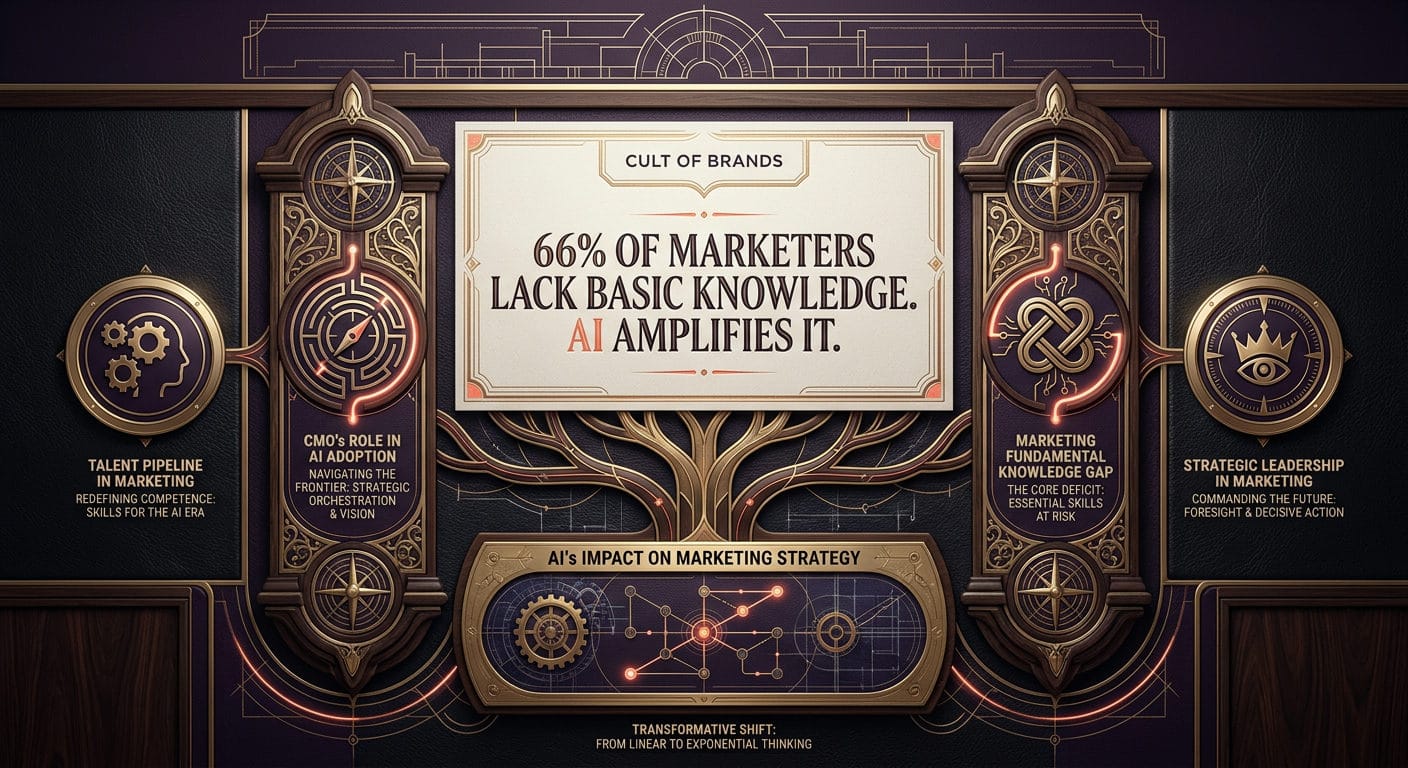
The marketing job market is facing an existential reckoning, demanding CMOs champion fundamental strategy and AI interoperability.
📊 10 episodes across 9 podcasts
⏱ 365 minutes of intelligence analyzed
🎙 Featuring: David Tiltman (WARC), Mark Ritson (Brand Thinker and Consultant), Mark Abraham (BCG), Elke Karskens (OpenAI)
|
One Big Thing
The marketing industry is at a critical inflection point, grappling with a widening knowledge gap among practitioners and the transformative, yet disruptive, power of AI. While the promise of AI for efficiency and growth is undeniable, a more pressing concern emerges: the fundamental understanding of marketing principles. This dichotomy—between technological velocity and strategic acumen—is shaping the future of the CMO role.
"Approximately 2/3 of marketers don't know those questions, don't know the answers. And we gave him multiple choice. So my beagle could have got, you know, two and a half out of 10."
— Mark Ritson, Educator and Columnist on The WARC Podcast
The Problem: Mark Ritson, on The WARC Podcast, starkly highlighted that an astonishing two-thirds of marketers lack basic theoretical knowledge. This "culture of bullshit," as he terms it, undermines the profession's credibility at a time when strategic leadership is most needed.
The AI Paradox: While AI is touted as a solution for scaling operations and generating content, its effectiveness is directly tied to the strategic sophistication of its users. Implementing generative AI without a robust understanding of core marketing principles risks amplifying poor strategy at unprecedented speeds. As James MacDonald, Founder of Limelight, noted on That's What I Call Marketing, "Simplicity wins. It's about being clear eyed and simple and direct about what we do with a tangible value." This clarity is impossible without foundational knowledge.
The CMO's Imperative: The leaders who will thrive are those who can bridge this gap: leading AI adoption not just for efficiency, but to amplify sound strategic thinking. This requires a double investment—in both cutting-edge AI interoperability and rigorous, enduring marketing education. CMOs must ensure their teams are not just prompt engineers, but strategic architects who can guide AI to produce genuine brand distinction and business value.
The Rundown
① AI's Impact on Junior Marketers Signals a Skills Shift.
Mark Ritson, Educator and Columnist, issued a stark warning about the future of early-career marketers, predicting that most junior roles are "instantly replaceable by AI" and that marketing job prospects for new entrants are limited (Mark Ritson on The WARC Podcast).
→ The Implication for CMOs: CMOs must proactively restructure their talent pipelines and upskill existing teams, focusing on strategic oversight and creative uniqueness rather than repetitive tasks, which AI will increasingly absorb.
② Interoperability, Not Proprietary AI, Wins in Ad Tech.
Limelight's approach to AI focuses on being the "most interoperable, oven ready, AI integrationable platform in the market," allowing clients to use their preferred AI tools rather than forcing them into a proprietary system (James MacDonald on That's What I Call Marketing).
→ The Implication for CMOs: When evaluating marketing technology stacks, prioritize solutions that enable seamless integration with diverse AI tools and data sources, allowing for greater flexibility and future-proofing your capabilities.
③ CMOs Are Leading AI Investment Decisions.
For the first time, over half of CMOs are in the "driver's seat on the AI investments and the decisions about those in the marketing function," signifying a critical shift in strategic ownership (Mark Abraham on Uncensored CMO).
→ The Implication for CMOs: Embrace this elevated responsibility by developing a clear AI investment roadmap that aligns with broader business objectives, and quantify the P&L impact of AI initiatives to solidify marketing's strategic role.
④ Profit Erosion Through Misguided Marketing Automation.
Aaron Spinley, Co-founder of Field Bell Institute, argued that many marketing automation strategies, particularly those focused on segment-based "abandoned cart" offers, can inadvertently "erode profit massively" through unnecessary price promotions (Aaron Spinley on CMO Confidential).
→ The Implication for CMOs: Re-evaluate your marketing automation flows to ensure they are designed for long-term customer base value rather than short-term transactional gains that may undermine profitability and brand equity.
⑤ Brevity in B2B Messaging Requires Radical Constraints.
Emma Ketterer, Global Lead Editor at Celonis, highlighted the challenge of concision in B2B marketing, emphasizing that companies often over-explain their value propositions, and true clarity emerges from a single, unifying idea (Emma Ketterer on On Brand with Nick Westergaard).
→ The Implication for CMOs: Apply "radical constraints" to your B2B messaging development, pushing for an "Eight Words or Fewer" micropitch that distills your brand's core value, allowing internal teams to align and external audiences to grasp your offering instantly.
Signal Board
💡 Heating Up
• CMO Leadership in AI Investment: CMOs are increasingly taking the lead on AI investment decisions within marketing, reflecting a recognition of its strategic importance (Mark Abraham on Uncensored CMO).
• AI-Driven Growth Initiatives: The focus on AI is shifting from mere efficiency gains to driving substantial growth, with measurable gains reported by B2C and B2B CMOs (Nadia on Uncensored CMO).
• Brand Intelligence Layer: The necessity of codifying brand intelligence with AI agents is becoming critical for effective deployment and consistent brand messaging across automated workflows (Mark Abraham on Uncensored CMO).
👀 On Watch
• Job Prospects for Junior Marketers 🆕: AI automation is predicted to significantly reduce job opportunities for entry-level marketing roles, necessitating a fundamental change in talent development (Mark Ritson on The WARC Podcast).
• Future Demand 🆕: Advertising's primary purpose is being reframed as creating future demand rather than merely persuading immediate purchases, altering how success is measured and capital allocated (Sleeping Barber on Sleeping Barber - A Marketing Podcast).
• Two-way Door Approach 🆕: A framework emphasizing decisions that are easily reversible, encouraging faster progress over perfection, is gaining traction among CMOs navigating rapid change (Lara Balazs on Uncensored CMO).
🧊 Cooling Off
• Net Promoter Score (NPS): Its effectiveness is being questioned as it's argued not to be a pre-indicator of sales performance, growth, or loyalty (Aaron Spinley on CMO Confidential).
• Proprietary AI Stacks: The focus is moving away from building unique, siloed AI solutions towards highly interoperable platforms that integrate various third-party AI tools (James MacDonald on That's What I Call Marketing).
• Marketing's "Culture of Bullshit": A critical view is emerging regarding the lack of fundamental marketing knowledge among practitioners, hindering strategic effectiveness and potentially undermining the profession (Mark Ritson on The WARC Podcast).
The Tension
The debate revolves around the role of AI in creative output: a tool for augmenting human creativity versus a threat to creative integrity.
🏛️ The Status Quo Doctrine: Many marketers view AI primarily as a tool for efficiency, particularly for scaling content creation and optimizing distribution, while reserving the core creative ideation process for humans. As Manu Orssaud, Chief Marketing Officer at Duolingo, noted, their brand strives "to be surprising fun where people don't expect us to be," a high bar for creative differentiation that many believe AI cannot yet consistently achieve.
🚀 The Challenger Doctrine: The counter-argument posits that AI, while a powerful accelerator, often leads to a "sea of sameness" in content, making true distinction harder to achieve. Creative leaders are wary of AI's limitations, particularly its tendency towards 'hallucinations' and the risk of compromising brand IP. Sandy Ono, formerly CMO of OpenText, emphasized, "What we're really, I think getting at is, is your brand distinct? Are your stories distinctive? Are you telling them in a way that is distinctive? And we're sort of calling that creativity." The act of creative ideation and truly distinct storytelling is seen as uniquely human.
The Advisor's Read: While AI's utility for velocity and scale is undisputed, the weight of evidence suggests that truly groundbreaking, brand-defining creativity still requires significant human ingenuity and discernment, making the balance between automation and human oversight paramount.
The Bottom Line
To survive the AI-driven market shakeout, CMOs must lead with strategic clarity, not just digital velocity, and invest in a deep understanding of core marketing principles to truly differentiate.
Toolkit
The "Eight Words or Fewer" Micropitch Diagnostic
Emma Ketterer and Adam Ketterer, authors of "Eight Words or Fewer," discussed how radical constraints in communication lead to greater clarity. Use these questions to distill your brand's core message:
- What is the single most important problem your brand solves for customers? Condense this into a concise statement.
- If you had to explain your brand's unique value in one breath, what would you say? Challenge yourself to remove all jargon and unnecessary descriptors.
- Which single benefit resonates most powerfully with your target audience? Focus on the ultimate gain, not just features.
- How does your brand fundamentally differ from the closest competitor, in its most essential form? This should reveal your true distinction.
- Can you articulate your brand's essence as a "micropitch" that acts as a strategic anchor for all communication? Strive for impact and memorability over comprehensive detail, ensuring this pithy statement guides brand strategy.
— Emma Ketterer (Global Lead Editor at Celonis) and Adam Ketterer (Co-founder of Beneath) on On Brand with Nick Westergaard
📖 Want the full episode breakdowns, guest details, and listen links?
Quick Appendix
CMO Confidential: "Aarron Spinley | The Concept of Customering - Is Technology Overwhelming the Customer Experience?" · 37 min · Featuring Aaron Spinley ▶ Listen
Audience Insight: Essential for CMOs rethinking customer retention strategies and how technology impacts genuine customer relationships beyond superficial metrics.
Renegade Marketers Unite: "526: AI Velocity vs. Human Creativity" · 51 min · Featuring Jakki Geiger ▶ Listen · Apple Podcasts
Audience Insight: A must-listen for CMOs balancing the deployment of AI for speed with the imperative to maintain brand distinctiveness and foster human creativity.
Sleeping Barber - A Marketing Podcast: "SBP 217: The PostPod - Lessons from James Hurman. Ads Don't Persuade People to Buy." · 25 min · Featuring Sleeping Barber ▶ Listen · Apple Podcasts
Audience Insight: Critical for CMOs seeking to reframe advertising objectives around long-term future demand generation and move beyond short-term persuasion metrics.
That's What I Call Marketing: "TWICM 204: Why Simplicity Wins in Ad Tech with Limelight Founder James MacDonald" · 29 min · Featuring James MacDonald ▶ Listen · Apple Podcasts
Audience Insight: Valuable for CMOs evaluating ad tech solutions, emphasizing the strategic advantage of interoperable platforms over proprietary systems.
The CMO Podcast: "From Murder Your Thirst to Electric Air Taxis: Creating Brand Desire // Lessons from Liquid Death, Duolingo, and Joby Aviation" · 33 min · Featuring Manu Orssaud ▶ Listen
Audience Insight: Insightful for CMOs tasked with creating deep brand desire in competitive or nascent categories, leveraging media strategically.
The CMO Show: "The Trust Deficit: What Marketers Must Do Next" · 37 min · Featuring Jo Osorio ▶ Listen · Apple Podcasts
Audience Insight: Indispensable for CMOs navigating declining public trust and seeking to build brand credibility through ethical conduct, competence, and localized communication.
The WARC Podcast: "Mark Ritson versus marketing's 'culture of bullsh*t'" · 38 min · Featuring Mark Ritson ▶ Listen · Apple Podcasts
Audience Insight: A challenging listen for any marketing leader concerned about the fundamental strategic knowledge gap within the industry and its implications for the future.
Uncensored CMO: "OpenAI on what every CMO needs to know about AI with BCG" · 42 min · Featuring Mark Abraham ▶ Listen · Apple Podcasts
Audience Insight: Essential for CMOs leading AI investment decisions and seeking to understand how to leverage AI for growth, not just efficiency, in marketing.
Uncensored CMO: "Why creativity matters more than ever in the age of AI - Adobe CMO, Lara Balazs" · 41 min · Featuring Lara Balazs ▶ Listen
Audience Insight: Highly relevant for CMOs driving rapid organizational change and fostering a culture that prioritizes progress over perfection and leverages AI for creative augmentation.
On Brand with Nick Westergaard: "Positioning in Eight Words (or Fewer!)" · 32 min · Featuring Emma Ketterer ▶ Listen · Apple Podcasts
Audience Insight: Practical advice for CMOs needing to distill complex value propositions into clear, concise, and memorable brand positioning.
