
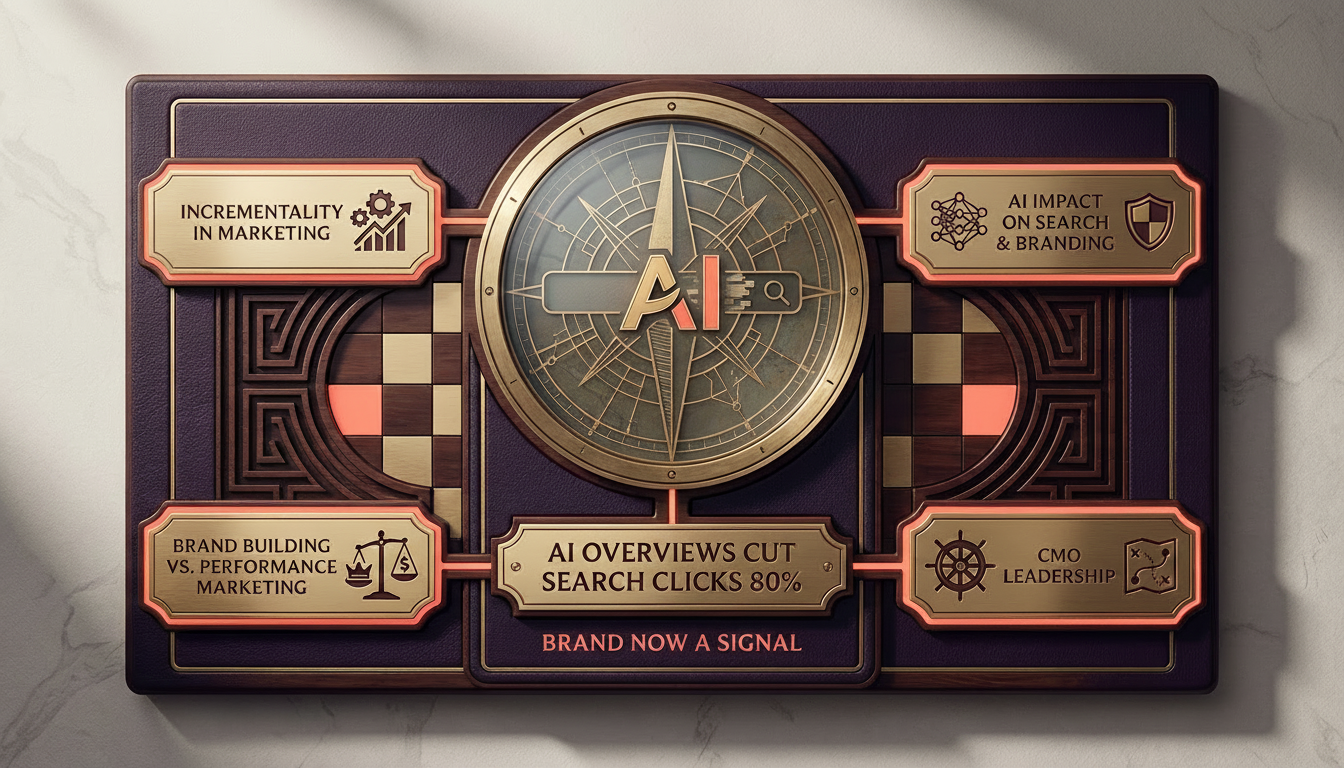
Marketing has found its voice in the boardroom: "Show me the incrementality, or your efficiency metrics are a hallucination."
The Intake
📊 10 episodes across 5 podcasts
⏱ 449 minutes of intelligence analyzed
🎙 Featuring: Drew Neiser (Renegade Marketing), Paige O'Neill (CMO, Culture Amp), Scott Gordon (CMO, HG Insights), Ali McCarthy (CMO, Asset-Map)
{{SPONSOR:sponsor_top}}
One Big Thing
The marketing industry is finally staring down a hard truth: many of the efficiency metrics worshipped for decades, especially in digital, are fundamentally misleading. This isn't just a critique; it's a fundamental re-evaluation of how marketing investment translates to business growth, forcing CMOs to articulate value in terms of genuine incrementality, not just last-click attribution or ROAS.
The Data Delusion: For too long, the ease of measuring digital channels fostered a belief that every click was an independent conversion. However, Mike Menkes, Vice President at Analytic Partners, highlights that "30% of paid search clicks are driven by other forms of marketing. So we're over crediting search." This over-crediting leads to flawed strategies. Jason McNellis, Senior Vice President at Analytic Partners, warns: "If you start making budget decisions with just treating all clicks the same, you are going to limit your growth. You will ignore the multiplier effect." The "efficiency trap" described by David Tiltman (Chief Content Officer at WARC) is that marketers optimize for metrics that look good, but fail to deliver real business impact, often because they misunderstand or misapply fundamental economic principles.
The Boardroom Imperative: The C-suite is growing wise to this problem. Rory McDonald, GM of Market Media at Amisia Retail Media Network, explicitly states the new metric of choice: "I think it's got to be incrementality. Anything else. Like it's what is the activity that you're actually doing Driving outside of just the customer." This means CMOs can no longer present budget requests based on easily manipulated ROAS figures. Instead, they must articulate how marketing spend demonstrably drives new customers, increases average order value, or expands market share that would not have occurred otherwise. The discussion on The WARC Podcast with Mike Menkes and Jason McNellis underscores this: CMOs must align their metrics with C-suite objectives, grounding marketing's contribution in actual business growth, not just channel-specific optimizations.
"If those companies can see it in the data, they will move because they will move where they can see the, the evidence takes them because they have the evidence."
— David Tiltman, Chief Content Officer at WARC, SVP of Content at Lions Intelligence on Sleeping Barber - A Marketing Podcast
Beyond the Echo Chamber: The Cannes discussions this week, particularly from David Tiltman on Sleeping Barber and Paul Darcy (CMO, Moloco) on That's What I Call Marketing, underscore a critical shift. The "Say/Do Gap" in marketing is shrinking, not because marketers are suddenly savvier, but because hard data and market pressures are exposing the inadequacy of outdated measurement. This forces a return to fundamentals: understanding how brand builds long-term demand and how specific marketing activities create incremental value. Without this shift, marketing risks being perpetually undervalued and relegated to the tactical.
The Rundown
① AI Accelerates a CMO's First 90 Days Beyond Traditional Learning.
The initial 90-day period for a CMO, conventionally a "listening tour," is now supercharged by AI's ability to synthesize vast amounts of organizational data and market insights, enabling quicker strategic formulation. (Paige O'Neill on Renegade Marketers Unite)
→ The Opportunity for CMOs: Leverage AI as a strategic co-pilot for rapid onboarding, transforming passive listening into accelerated, data-driven action that establishes early credibility and momentum.
② Brand Fit Far Outweighs Follower Count in Creator Marketing.
System1 research indicates that a creator's alignment with brand values and distinctiveness is twice as impactful for brand growth than their follower count or engagement rates, challenging conventional influencer metrics. (Andrew Tindall on Sleeping Barber - A Marketing Podcast)
→ The Imperative for CMOs: Re-evaluate creator marketing strategies to prioritize authentic brand integration and emotional resonance over vanity metrics, investing in creators who embody the brand's essence to drive genuine memory and distinctiveness.
③ AI Overviews Drastically Reduce Search Clicks, Elevating Brand's Role as a Signal.
AI overviews in search results are causing an 80% reduction in user clicks on traditional links, diminishing the influence of digital intermediaries and making a strong brand an essential signal for visibility within LLMs. (Paul Darcy on That's What I Call Marketing)
→ The Strategic Shift for CMOs: Invest aggressively in brand building to ensure direct recognition and authority, mitigating dependency on traditional search mechanisms that are being disrupted by AI-driven zero-click environments.
④ Creative Risk-Taking is the Lowest Risk Strategy in an Efficiency-Obsessed Era.
Amidst calls for efficiency, Fernando Machado (Chief Brand Officer, Chipotle) argues that the greatest risk is producing average, forgettable work, while strategic creative risks act as a "dollar multiplier" for investment. (Fernando Machado on The WARC Podcast)
→ The Call to Action for CMOs: Champion bold creativity as a fundamental growth engine, prioritizing campaigns that stand out and cut through the noise, rather than succumbing to the allure of safe, incremental efficiency plays.
⑤ Legacy Brand Investment Compounds in Consumer Decision-Making.
Long-term World Cup sponsorships by brands like Coca-Cola and Adidas demonstrate how sustained brand investment consistently translates into top-tier awareness, consideration, and preference across the brand funnel. (Ed Parkin on That's What I Call Marketing)
→ The Long-Term Play for CMOs: Advocate for consistent, compounding brand investment, providing clear evidence of how brand equity, built over time, underpins all stages of the customer journey, from awareness to preference.
⑥ The Science of Brand Associations Remains Underutilized Despite Clear Evidence.
Ulli Appelbaum's research shows that while brand associations are foundational for consumer choice and memory, the marketing industry frequently overlooks these proven principles in favor of fleeting trends or superficial metrics. (Ulli Appelbaum on JUST Branding)
→ The Foundation for CMOs: Return to foundational principles of brand association and memory formation, ensuring marketing strategies are scientifically grounded to build enduring emotional connections and distinctiveness, rather than chasing fads.
Signal Board
🚀 HEATING UP
• Brand Associations: The foundational role of creating strong, positive memories is gaining renewed focus as a scientific, data-driven approach to consumer choice and business growth. (Ulli Appelbaum on JUST Branding)
• First 90 Days in CMO Role: AI is fundamentally transforming the onboarding process, allowing new CMOs to synthesize information and drive impact faster than ever before. (Paige O'Neill on Renegade Marketers Unite)
• Incrementality in marketing measurement: This is becoming the new gold standard to determine true marketing effectiveness, moving beyond misleading efficiency metrics. (Rory McDonald on That's What I Call Marketing)
🆕 ON WATCH
• AI disruption of digital brands: AI overviews are drastically reducing clicks on traditional search results, signaling a fundamental shift in how digital brands gain visibility. (Paul Darcy on That's What I Call Marketing)
• Social devices and repeatable creative concepts in creator marketing: These offer a powerful way for brands to achieve authentic integration and compounded recognition within creator content. (Marc on Sleeping Barber - A Marketing Podcast)
• Performance metrics mislead marketing impact: There's growing recognition that metrics like ROAS can be easily manipulated and frequently misattribute value, leading to suboptimal investment. (Mike Menkes on The WARC Podcast)
• The Science of Brand Associations: A structured approach to understanding and building consumer perceptions, despite being critically underrated by the industry at large. (Ulli Appelbaum on JUST Branding)
• Multiplier Effect: Acknowledging that one marketing activity can amplify others, driving greater overall impact than isolated channel measurement suggests. (Jason McNellis on The WARC Podcast)
• Click-through rates (CTR) are misleading due to zero-click behavior: AI overviews are reducing the necessity for users to click through, making CTR an increasingly unreliable indicator of engagement. (Paul Darcy on That's What I Call Marketing)
• Unlocking stalled team projects for quick wins: Part of a new CMO's accelerated first 90 days involves identifying and resolving bottlenecks to demonstrate immediate value. (Scott Gordon on Renegade Marketers Unite)
🧊 COOLING OFF
• ROAS (Return on Ad Spend) as a misleading metric: Increasingly viewed as a manipulable and insufficient metric that fails to capture true business impact. (Rory McDonald on That's What I Call Marketing)
• Last click attribution still widely and incorrectly used: Despite evidence of its flaws, many organizations continue to disproportionately credit the last touchpoint in a customer journey. (Mike Menkes on The WARC Podcast)
The Tension
The conversation around growth in marketing is split between strategies that emphasize "big", broad reach via traditional advertising and those prioritizing "lots of little" digital engagements for efficiency.
"We've become so obsessed with efficiency in advertising that we've forgotten about the importance of scale, about needing to invest enough to get enough exposure to reach enough people to go broad enough to use enough media and to produce creative that people want to watch."
— Les Binet, Author, Consultant, Marketing Professor at IPA on The WARC Podcast
🏛️ The Status Quo Doctrine: Les Binet, a renowned marketing effectiveness expert, champions the "big" approach, arguing for significant investment in broad-reach media and compelling creative that breaks through the noise. This doctrine holds that true growth comes from scale and memorability, not just targeted efficiency. Mel Arrow, CEO of McCann London, echoes this, stating, "I think they have to play together... In advertising, it still has to be very compelling."
"It's much more common to see a brand overspend on performance than it is to see a brand overspend on brand. And that's sometimes where maybe we sound like we're harping on it."
— Jason McNellis, Senior Vice President at Analytic Partners on The WARC Podcast
🚀 The Challenger Doctrine: Conversely, others argue that an over-reliance on efficiency metrics like ROAS, while flawed, often drives substantial investment in "lots of little" highly targeted digital tactics. This perspective, sometimes driven by C-suite demands for immediate, measurable returns, can lead to brands overspending on performance at the expense of brand building. The risk here, as emphasized by Analytic Partners' Jason McNellis, is ignoring the "multiplier effect" that brand campaigns have on the efficiency of performance channels.
The Advisor's Read: While the pendulum often swings between these two, the weight of evidence increasingly suggests that balancing both "big" brand building and "little" performance marketing is essential, with a renewed understanding that effective brand work improves the efficiency of all other marketing efforts.
The Bottom Line
The new mandate for CMOs is clear: shed the illusion of tactical efficiency, embrace data-backed incrementality, and lead with the business acumen to prove marketing's unequivocal impact on enterprise value.
Toolkit
Diagnostic for CMO-CFO Alignment on Marketing Investment
To bridge the "Say/Do Gap" and align marketing strategy with the C-suite, CMOs must proactively frame marketing's contribution in language that resonates with financial stakeholders. Use these questions to diagnose and strengthen your C-suite alignment:
- Do we have a shared understanding and single source of truth for key metrics beyond basic ROI, such as incrementality, customer lifetime value, or marketing-attributable profit?
- Are we utilizing data-driven scenario planning to demonstrate the impact of marketing budget changes on broader business KPIs like price premiums, sales volume, and long-term brand equity?
- Does our marketing plan explicitly connect investments to overall business growth goals, rather than merely optimizing for channel-specific efficiencies?
- Have we invested in educating the CFO and other C-suite members on how marketing fundamentally works, including the "multiplier effect" of brand building on performance channels?
- Are we actively seeking to seed business-critical marketing insights with the CRO, biz ops, and CFO before formal proposals, to build trust and reinforce marketing's strategic influence?
— Mike Menkes & Jason McNellis, Analytic Partners on The WARC Podcast
📖 Want the full episode breakdowns, guest details, and listen links?
Quick Appendix
JUST Branding: "S07.EP10 - The Science of Brand Associations with Ulli Appelbaum" · 61 min · Featuring Ulli Appelbaum (Founder, Author of The Science of Brand Associations, First The Trousers)
Strategic Relevance: Essential for CMOs seeking to ground their brand strategies in scientific principles and build long-lasting emotional connections with consumers.
Renegade Marketers Unite: "524: The First 90 Days Just Got Faster" · 50 min · Featuring Paige O'Neill (CMO, Culture Amp)
Strategic Relevance: Critical for new CMOs or those advising them, offering actionable insights on leveraging AI and structured approaches to accelerate impact in the crucial first 90 days.
Sleeping Barber - A Marketing Podcast: "SBP 212: The Cannes Cut - Brand Fit Beats Follower Count" · 49 min · Featuring Andrew Tindall (Chief Growth Officer, System1)
Strategic Relevance: Invaluable for CMOs navigating creator marketing, providing data-backed evidence to shift focus from vanity metrics to authentic brand fit and distinctiveness.
Sleeping Barber - A Marketing Podcast: "SBP 214: The Cannes Cut - The Gap Between Knowing and Doing: Day 5 Reflections. Featuring David Tiltman." · 59 min · Featuring David Tiltman (Chief Content Officer at WARC, SVP of Content at Lions Intelligence)
Strategic Relevance: Essential for CMOs struggling with C-suite alignment, providing frameworks to bridge the "Say/Do Gap" and articulate marketing's strategic value in business-centric terms.
That's What I Call Marketing: "The Cannes Sessions Day 3 - Daily Round Up 24/06/2026" · 21 min · Featuring Paul Darcy (CMO, Moloco)
Strategic Relevance: Crucial for CMOs preparing for an AI-first search landscape, highlighting the increasing importance of brand as a direct signal to LLMs amidst declining click-through rates.
That's What I Call Marketing: "The Cannes Sessions Day 4 - Daily Round Up 25/06/2026" · 29 min · Featuring Jill Kramer (CMO, Mastercard)
Strategic Relevance: Provides CMOs with insights into the shift towards incrementality in retail media and how AI can streamline compliance in regulated industries, fostering growth amidst complexity.
That's What I Call Marketing: "The Singles: The hot hits of June with The World Cup, Spotify, Brew Dog & The Lotto" · 30 min · Featuring Ed Parkin (Co-founder, Tracksuit)
Strategic Relevance: Offers CMOs a deep dive into the compounding power of long-term brand investment and the critical importance of distinctiveness in an increasingly commoditized content landscape.
The WARC Podcast: "Live in Cannes: Building brands in the efficiency era" · 51 min · Featuring Fernando Machado (Chief Brand Officer, Chipotle)
Strategic Relevance: Essential for CMOs seeking to defend creative risk-taking, arguing that bold, memorable work is the most effective growth engine, especially in challenging economic times.
The WARC Podcast: "Live in Cannes: The new, old rules of brand growth" · 63 min · Featuring Les Binet (Author, Consultant, Marketing Professor, IPA)
Strategic Relevance: Offers CMOs a strategic perspective on balancing "big" brand advertising with "lots of little" digital engagements, emphasizing the need for scale and memorability to drive long-term growth.
The WARC Podcast: "Why C-suite alignment is an urgent marketing priority" · 36 min · Featuring Mike Menkes (Vice President, Analytic Partners)
Strategic Relevance: Vital for CMOs needing to bridge the gap with CFOs, offering actionable strategies for data-driven scenario planning and aligning marketing metrics with overall business objectives.
