
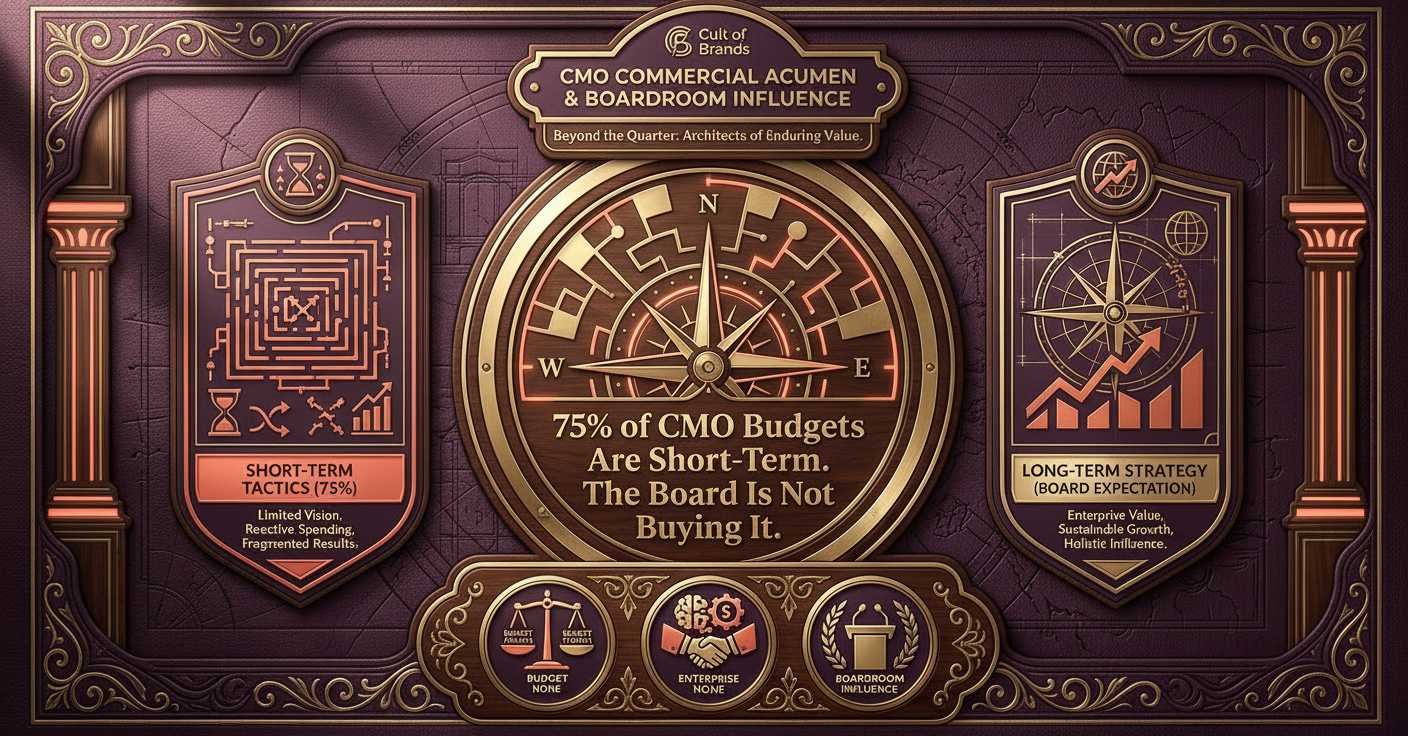
The CMO's toughest challenge isn't the market, it's the boardroom: navigating short-term demands while building long-term enterprise value.
The Intake
📊 10 episodes across 6 podcasts
⏱ 390 minutes of intelligence analyzed
🎙 Featuring: Drew Neiser (Host and Chief Marketing Renegade, Renegade Marketers Unite), Hugh Marshall (Senior Executive, Marketing Practice, Heidrick & Struggles), Jon Evans (Host, Uncensored CMO)
{{SPONSOR:sponsor_top}}
One Big Thing
The CMO role is at a critical juncture, with leaders needing to transcend traditional marketing functions and adopt a deep commercial mindset to drive board-level influence and long-term value, moving beyond short-term metrics to holistic business impact.
The Imperative for Commercial Acumen: Michael Lacorazza, EVP and CMO of U.S. Bank, unequivocally states the fundamental shift required for marketing leaders: "Single biggest piece of advice is any CMO who aspired to move into a president or CEO role, have the utmost commercial mindset, understand how the company makes money in the P and L and the drivers of the outcomes, understand what your customers expect from you." This isn't about mere financial literacy; it's about embedding marketing strategy within the core financial architecture of the business, understanding contribution margins, and shaping value creation.
Bridging the Perception Gap: This commercial imperative is crucial because marketing often struggles for influence where it matters most. Jon Evans, Host of Uncensored CMO, highlighted a stark reality from a TikTok survey, noting, "A third of the best companies in the world don't have marketing representation. More than 50% said there's no one with marketing experience on the board." This lack of representation underscores a systemic undervaluing of marketing's strategic contribution at the highest levels, often due to a perceived inability to speak the language of enterprise value.
Strategic Time Horizon: The tension between long-term brand building and short-term performance is exacerbated by this disconnect. Susan O'Brien, Former CMO of Just Eat, observed, "Over 75% of people are spending more than half their budget on short term over long. There's a real short term imbalance going on." To counteract this, she advocates for a significant shift in planning: "The moment you change your time horizon, suddenly you change your decisions. You know, and I think we need, as marketers, we need to start presenting three, five, ten year plans rather than six month plans." This shift from campaign-centric to strategy-centric planning, grounded in commercial understanding, is the CMO's path to the C-suite and board. The challenge lies not in what marketing does, but in how its value is articulated and integrated into core business strategy and financial planning.
"My one big learning coming out of that organization was the value of customer centricity and putting the customer front and center of all your decisions. And it sounds maybe sometimes a little bit trite, but it's absolutely kind of foundational to who I am as a leader and how I think about my world."
— Michael Lacorazza, EVP and CMO of U.S. Bank on Marketing Vanguard
The Rundown
① Traditional Marketing Funnels Fail to Capture Modern Buyer Behavior.
Marc and Vassilis on Sleeping Barber - A Marketing Podcast discussed how idealized linear models like funnels don't reflect the messy, non-linear reality of how buyers make decisions, with 84% of purchases rooted in pre-existing brand leanings.
→ Marketing's Call to Action: Shift from prescriptive funnel management to understanding probability-based buying models and the deeper psychological drivers behind customer choice, particularly the B2B fear of regret.
② Brands Need a "Strategic Enemy" to Sharpen Positioning.
Laura Ries, Global Positioning Strategist at Ries, argued on Brand Master Podcast that defining what a brand stands against is the most effective way to clarify what it stands for, enabling "branding with balls."
→ The Implication for CMOs: Reframe competitive analysis to identify not just rivals, but conceptual adversaries that allow your brand story to resonate with greater clarity and distinctiveness, especially in crowded markets.
③ AI and Humans Prefer Dramatically Different Ads.
New research discussed on The WARC Podcast revealed zero correlation between ads preferred by humans (emotional, narrative-driven) and those by AI (descriptive, product-focused), suggesting a bifurcated creative landscape.
→ Marketing's Call to Action: Develop hybrid creative strategies that optimize for both human resonance and AI discoverability, recognizing that luxury and premium categories face particular challenges with AI's current processing.
④ The CMO's Job Search Demands More Than Just Expertise.
Hugh Marshall from Heidrick & Struggles on Renegade Marketers Unite emphasized the need for CMO candidates to demonstrate intense interest, long-term commitment, and diligence on employer viability, especially in competitive and high-turnover roles.
→ The Implication for CMOs: Beyond marketing prowess, cultivate an executive presence that signals genuine strategic partnership and dedication, backing it with thorough due diligence on organizational health and equity structures.
⑤ Global Ad Spend Shows Resilience Despite Economic Volatility.
Kate Scott-Dawkins, Global President for Business Intelligence at WPP Media, noted on The WARC Podcast that despite consumer pessimism, global ad spend is projected to grow significantly, reaching its highest share of GDP since 1999.
→ The Implication for CMOs: Understand that advertising is increasingly seen as a business investment rather than pure promotion, with factors like cross-border spend and AI investment providing a floor for growth even amidst uncertainty.
Signal Board
💡 Heating Up
• Agentic Commerce / LLMs: The current influx of 'agentic commerce' where AI agents can shop on behalf of consumers is a rapidly emerging trend that necessitates businesses to capture every data point from these new interaction channels. (Jamie Domenici on Uncensored CMO)
• Mental Availability: Byron Sharp's concept of mental availability and sophisticated mass marketing were repeatedly highlighted as crucial for brand growth, even amidst calls for one-to-one targeting. (Marc on Sleeping Barber - A Marketing Podcast)
• Customer Experience: Jamie Domenici, CMO of Klaviyo, stressed the critical role of superior customer experience as a primary growth driver, emphasizing understanding the entire customer journey. (Jamie Domenici on Uncensored CMO)
👀 On Watch
• B2B buying committee influence: 40-60% of qualified B2B deals fail because buyers fear making a decision they might be blamed for later, rather than missing out on a better option. (Marc on Sleeping Barber - A Marketing Podcast)
• Generative search ad revenue explosion: Generative search ad revenues are predicted to increase nearly twenty-fold from $5.1 billion in 2026 to over $100 billion by 2030. (Anna Hamill on The WARC Podcast)
• CMO Opportunities in AI-Native Businesses: Most AI-native companies prioritize a CMO's hyperscale experience and ability to drive growth over their explicit AI credibility or fluency in marketing leadership roles. (Hugh Marshall on Renegade Marketers Unite)
❄️ Cooling Off
• Marketing Funnel: Traditional marketing funnels and customer journey maps are considered inadequate for representing modern, messy, and non-linear buying behavior. (Marc on Sleeping Barber - A Marketing Podcast)
• Brand Purpose in Marketing Effectiveness: Byron Sharp and Mark Ritson remain outspoken critics of marketers' movement towards brand purpose as an advertising tactic, not seeing a credible link between purpose and business outcomes. (David Tiltman on The WARC Podcast)
• One-to-one digital targeting for growth: Vanessa Chin, SVP of Marketing at System1, highlighted that while one-to-one marketing has its place, it's not the driver for brand growth, which still relies on sophisticated mass marketing. (Vanessa Chin on Sleeping Barber - A Marketing Podcast)
The Bottom Line
To truly lead, CMOs must pivot from marketing tactics to commercial strategy, becoming fluent in P&L and board dynamics to secure marketing's rightful place as a strategic growth engine.
Toolkit
The Strategic Enemy Framework
Laura Ries suggests that brands can sharpen their positioning by identifying a "strategic enemy." This enemy isn't always a direct competitor; it can be a concept, a category, or a convention. By clarifying what your brand stands against, you simultaneously clarify what it stands for.
Applying the Framework:
- Identify Your Adversary: Is it a competitor? An outdated industry standard? A common consumer behavior your product aims to disrupt (e.g., DiGiorno vs. delivery)?
- Articulate the Contrast: Clearly define the differences between your brand and its chosen enemy. What problem does the enemy represent that your brand solves?
- Communicate with Clarity & Courage: As Ries notes, "At the end of the day, while the strategy is one part, a huge other part is the courage to do it." Use this opposition to fuel your messaging and positioning.
This framework provides a mechanism for CMOs to create more compelling narratives and gain mental availability by standing out in a crowded market. (Laura Ries on Brand Master Podcast)
📖 Want the full episode breakdowns, guest details, and listen links?
Quick Appendix
The WARC Podcast: "Economic volatility stress-tests the global advertising market" · 26 min · Featuring Anna Hamill ▶ Listen · Apple Podcasts
Who Should Listen: Marketing leaders and strategists needing a macroeconomic outlook on global ad spend trends and the influence of AI on future growth.
The WARC Podcast: "Live in Cannes: The effectiveness experts will see you now" · 44 min · Featuring Ann Marie Kerwin ▶ Listen · Apple Podcasts
Who Should Listen: CMOs and brand managers interested in effectiveness research, the Byron Sharp vs. Mark Ritson debate, and the challenges of influencer marketing ROI.
Sleeping Barber - A Marketing Podcast: "SBP 209: The Sharp Cut - Buyers Don't Move in Straight Lines" · 20 min · Featuring Marc ▶ Listen · Apple Podcasts
Who Should Listen: Marketing and sales leaders looking to challenge traditional funnel thinking and understand modern, non-linear buying behaviors, especially the psychology of B2B purchase paralysis.
Renegade Marketers Unite: "523: The CMO Job Search Is a Two-Way Street" · 45 min · Featuring Drew Neiser ▶ Listen · Apple Podcasts
Who Should Listen: Aspiring CMOs and current marketing executives navigating leadership transitions, particularly for insights into PE-backed roles and demonstrating long-term value.
Uncensored CMO: "The real 4 P's of the CMO with Susan O'Brien (Just Eat)" · 58 min · Featuring Susan O'Brien ▶ Listen · Apple Podcasts
Who Should Listen: CMOs seeking to broaden their influence beyond pure marketing, focusing on leadership, people management, and internal stakeholder persuasion at the executive level.
Marketing Vanguard: "The CMO’s Secret to Board-Level Influence ft. Michael Lacorazza" · 28 min · Featuring Michael Lacorazza ▶ Listen · Apple Podcasts
Who Should Listen: Marketing executives aiming to elevate their strategic influence and demonstrate clear commercial value to the CEO and board by mastering P&L and customer-centricity.
Brand Master Podcast: "310 | Why Every Great Brand Needs an Enemy with Laura Ries" · 39 min · Featuring Stephen Houraghan ▶ Listen · Apple Podcasts
Who Should Listen: Brand strategists and marketing leaders looking to sharpen their brand positioning by identifying and campaigning against a "strategic enemy" to create stronger brand clarity.
The WARC Podcast: "Live in Cannes: Creative strategy in a changing world" · 45 min · Featuring Rica Facundo ▶ Listen · Apple Podcasts
Who Should Listen: Creative directors and brand managers navigating the tension between human-preferred emotional advertising and AI-preferred descriptive ads in a globally fragmented market.
Uncensored CMO: "The power of incredible customer experience - Jamie Domenici, Klaviyo" · 45 min · Featuring Jamie Domenici ▶ Listen
Who Should Listen: CMOs and customer experience leaders focused on leveraging customer experience as a primary growth driver, particularly in B2C contexts and the evolving role of AI in CRM.
Sleeping Barber - A Marketing Podcast: "SBP 210: The Cannes Cut - Creativity That Works: Cannes Day 1 Reflections" · 40 min · Featuring Marc ▶ Listen · Apple Podcasts
Who Should Listen: Marketing leaders interested in the convergence of creativity and effectiveness, the role of humor in advertising, and the practical integration of AI within organizations.
