
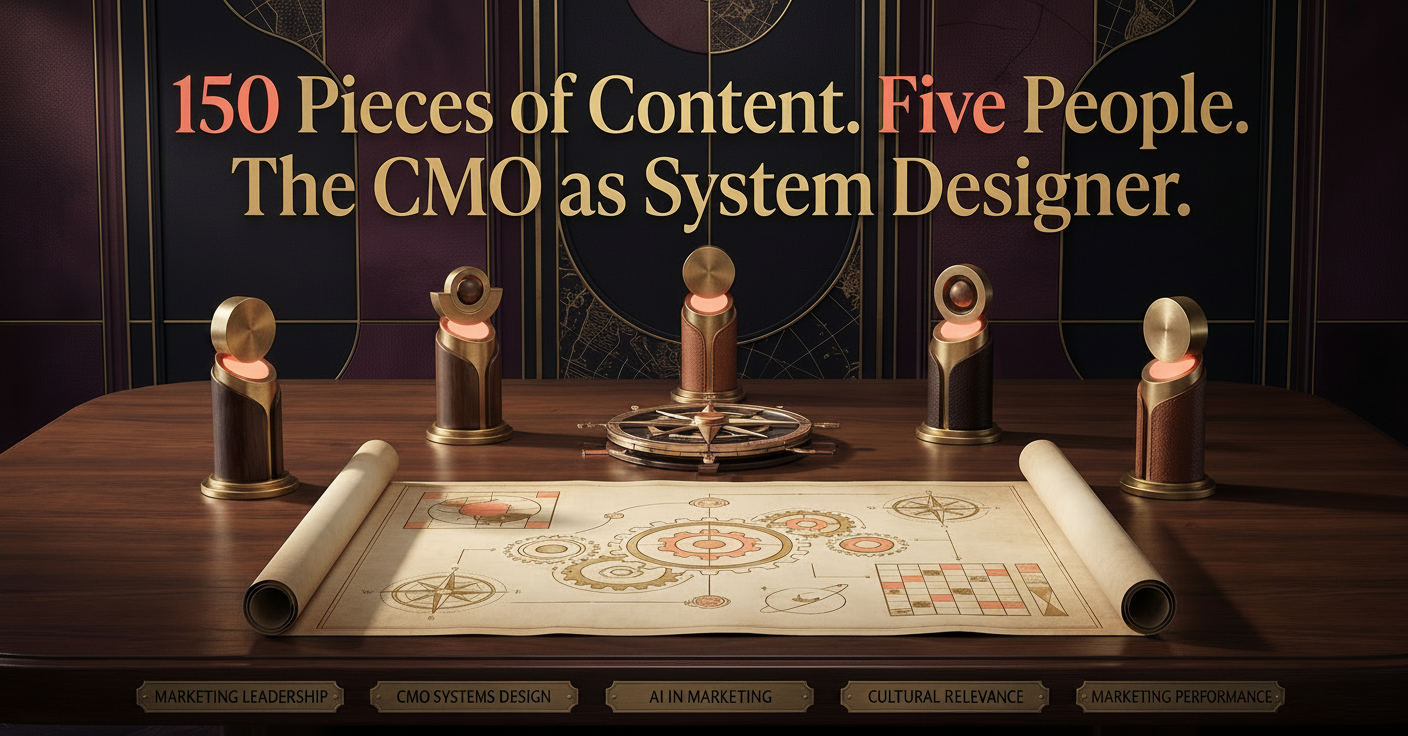
The marketing battleground has decisively shifted from brand messaging to systems design and cultural relevance.
📊 10 episodes across 8 podcasts
⏱ 377 minutes of intelligence analyzed
🎙 Featuring: Sleeping Barber, Mark Binkley, Vasilis Duras
|
One Big Thing
The definition of marketing leadership is undergoing a radical transformation, moving definitively from the individual "hero leader" to the "system designer." In an increasingly complex and AI-driven landscape, CMOs are no longer expected to personally possess all answers or make every decision. Instead, their core mandate is to engineer agile, efficient operating models that enable teams to consistently generate high-quality output at scale.
This organizational design imperative was a consistent undercurrent across multiple discussions this week. As Renegade Marketers Unite highlighted, the most effective leaders recognize that their job isn't to "win the game," but to "design the machine that wins consistently." This means leveraging AI not to replace staff, but to augment existing teams, making them exponentially more efficient. For instance, Dan Lowden, CMO of Blackbird.AI, demonstrated this by revealing how his five-person team produces 150 pieces of annual content through systematized workflows and AI. This shift demands a focus on process automation, training, and continuous feedback loops, embracing what Katrina Klier, CMO of eSource, called the necessity to "coach AI agents to be better" like hiring a new team member.
"The biggest thing is that the job of a leader isn't to win the game. It's to design the machine that wins consistently."
— Chris Pieper, VP of Marketing at ADP on Renegade Marketers Unite
Beyond internal systems, the external market requires cultural acuity. As discussed on That's What I Call Marketing, brands like Lucky Saint and Lego succeed by leveraging cultural moments and integrating seamlessly into consumer lifestyles, demonstrating a new form of "showmanship" that prioritizes entertainment and organic reach over traditional "salesmanship." This dual focus—internal systems design and external cultural relevance—defines the modern CMO's strategic mandate.
The Rundown
① Purpose Campaigns Are Actively Underperforming.
Analyses from the Ehrenberg-Bass Institute and Peter Field indicate that brand purpose campaigns, on average, underperform non-purpose campaigns, with a potential downside of actively harming performance if executed poorly. (Sleeping Barber - A Marketing Podcast)
→ The Strategic P&L Implications: Marketing leaders must rigorously evaluate the tangible business impacts of purpose-driven initiatives, particularly given the low consumer awareness of such efforts, and reallocate resources towards more commercially effective strategies.
② Creative Instinct Outperforms Data-Driven Sameness.
Veteran ad maker Terry O'Reilly argues that marketing has become too reliant on data, leading to generic and forgettable ads. He advocates instead for bold creative risks and gut instincts, exemplified by successful, unconventional campaigns like Fiberglass Pink insulation. (Terry O'Reilly on Sleeping Barber - A Marketing Podcast)
→ Investment in Differentiation: CMOs should challenge their agencies to produce "work that scares you," fostering a culture that prioritizes creative distinctiveness and memorable advertising over statistically safe but ultimately invisible campaigns, as creativity correlates with significant business gains.
③ Social Media Engagement Peaks When People Are Out of Home.
New research from The Point of Social study 🆕 shows that contrary to intuition, social media experiences are 6% more positive and more likely to drive product exploration when users are engaged while out of home, particularly when with others, creating a synergistic opportunity with OOH advertising. (Ciara Smyth on The WARC Podcast)
→ Optimized Channel Integration: Marketing leaders should reconsider the timing and context of social media ad placements, aligning them with out-of-home campaigns and shared cultural moments to capitalize on enhanced engagement and drive action, shifting OOH from an upper-funnel channel to a "daytime performance enabler."
④ Founder Branding Directly Impacts Business Valuation.
Amelia Sordell, Founder and CEO of Klowt, emphasizes that a founder's personal brand significantly impacts the valuation of a business, often equating to 40-50% of its market value, and is crucial for building trust in an era where consumers distrust brands. (Amelia Sordell on JUST Branding)
→ Strategic Founder Integration: CMOs should strategically integrate founder branding into their overall marketing plans, fostering authentic personal brand development as a trust-building asset that complements company branding and attracts both community engagement and qualified leads, rather than viewing it as a separate or optional endeavor.
⑤ AI's Biggest Impact is Bottom-Up Efficiency, Not Top-Down Strategy.
Jean English, CMO of CoreWeave, highlights that AI adoption is most impactful when driven from the bottom up, enabling marketing teams to scale operations and innovate through internal hackathons and personal usage. (Jean English on CMO Confidential)
→ Empowerment Through AI: Marketing leaders should focus on equipping their teams with AI tools and fostering a culture of experimentation and proficiency, recognizing that AI-driven efficiency for tasks like content generation and multi-touch attribution analysis is critical for scaling talent and output. English noted that "Marketing is a great function and use case for AI. The only way for us to scale was to use AI."
Signal Board
👍 Heating Up
• Keisha Taylor Starr 🆕: Her career trajectory highlights a successful CMO transition to General Manager with full P&L responsibility. (Jenny Rooney on Marketing Vanguard)
• CoreWeave: Specialized AI cloud infrastructure is seeing intense demand as businesses shift from AI model training to inference. (Jean English on CMO Confidential)
• Lego: Continues to demonstrate unique success by appealing consistently across all demographics, driven by cultural relevance and strategic campaign timing. (Bella Harrison on That's What I Call Marketing)
• Lucky Saint: Excelling in the mainstream non-alcoholic beer category through cultural integration and partnerships. (Ed Parkin on That's What I Call Marketing)
• Independent validation of marketing performance: Emphasized as crucial by Michael Kaminsky to avoid being swayed by vendor claims. (Michael Kaminsky on The WARC Podcast)
👀 On Watch
• ION 🆕: Transformed into a women's sports powerhouse through strategic programming investments. (Keisha Taylor Starr on Marketing Vanguard)
• Terry O'Reilly 🆕: Veteran ad maker whose insights advocate for creative boldness over data-driven sameness. (Sleeping Barber - A Marketing Podcast)
• Amelia Sordell 🆕: Highlights the increasing importance of founder branding for business valuation and trust. (Amelia Sordell on JUST Branding)
• The Point of Social study 🆕: New research uncovering unexpected synergies between out-of-home and social media. (Russell Smither on The WARC Podcast)
• Intuitive Intelligence: Identified as one of three essential human skills for an AI-driven world by Elizabeth Rosenberg. (Elizabeth Rosenberg on On Brand with Nick Westergaard)
📉 Cooling Off
• Brand Purpose Effectiveness: Data suggests average purpose campaigns underperform non-purpose campaigns and have low consumer awareness. (Sleeping Barber - A Marketing Podcast)
• LLMs for marketing measurement: Skepticism is growing regarding their practical value for complex measurement problems, especially for smaller brands. (Michael Kaminsky on The WARC Podcast)
• Data-driven Marketing vs. Instinct: Current marketing over-reliance on data is leading to generic advertising, diminishing creative impact. (Terry O'Reilly on Sleeping Barber - A Marketing Podcast)
• AI as a solution for data cleanup in marketing: Its benefits are overstated, as many teams have already addressed these issues with existing tools. (Michael Kaminsky on The WARC Podcast)
• Generic AI content creation: Leads to homogenized "ChatGPT tone of voice," lacking unique brand voice and true impact. (Amelia Sordell on JUST Branding)
The Tension
The marketing industry is grappling with whether success in an AI-driven world demands a rigorous, data-first approach or a return to bold creative instinct.
🏛️ The Status Quo Doctrine: The widespread industry belief posits that rigorous measurement and data-driven insights are paramount, especially given the complexities of omnichannel marketing and new tech. Michael Kaminsky, Co-founder at Recast, articulated this, stressing that "Every marketing team, every budget holder, every CMO should be thinking about, hey, what am I really getting for these dollars or pounds or euros that I'm investing?" during his discussion on The WARC Podcast. This camp emphasizes vigilance against "snake oil vendors" and the need for independent validation to ensure true incrementality.
🚀 The Challenger Doctrine: A counter-narrative, championed by veteran ad creative Terry O'Reilly on Sleeping Barber - A Marketing Podcast, argues that an over-reliance on data has stifled creativity, leading to generic and forgettable advertising. O'Reilly passionately stated, "I do think the industry has lost that aspect of itself which is to rely on your instincts and gut feelings." He points to historically successful, counter-intuitive campaigns that defied data, asserting that top-tier creative work, often bold and even initially "scary," is what truly drives significant business gains.
The Advisor's Read: While data provides guardrails against wasted spend, true competitive advantage arises from the intersection of robust systems design and fearless creative leadership.
The Bottom Line
To lead effectively in marketing today, you must architect the growth engine and wield cultural relevance as your sharpest creative tool.
Toolkit: The CMO as System Designer
Katrina Klier (CMO of eSource) and Chris Pieper (VP of Marketing, ADP) on Renegade Marketers Unite outlined a shift from individual "hero leaders" to "system designers." This framework helps CMOs build resilient, scalable marketing organizations:
- Audit Resource Categories: Categorize your marketing team's assets into People, Tech, and AI. Understand current capabilities and identify gaps.
- Define Core Operating Models: Map out critical workflows (e.g., content generation, ABM, measurement). How can AI augment each step for efficiency and scale?
- Implement Agile Sprints: For initiatives like Account-Based Marketing, adopt three-week sprints with clear metrics for business outcomes, execution discipline, and team health.
- Foster an "AI-First" Mindset: Shift thinking from "AI for leaner companies" to "AI for exponentially more efficient existing teams." Empower bottom-up AI adoption.
- Coach and Feedback: Treat AI agents and tools like new team members, providing continuous coaching and feedback to "tune, tweak, and adjust" for better performance.
📖 Want the full episode breakdowns, guest details, and listen links?
Quick Appendix
CMO Confidential: "Jean English | The AI Marketing Battle: A View from the Front Lines" · 35 min · Featuring Jean English ▶ Listen
JUST Branding: "S07.EP7 - Founder Branding with Amelia Sordell" · 55 min · Featuring Amelia Sordell ▶ Listen
Marketing Vanguard: "How Keisha Taylor Starr Turned ION Into a Women's Sports Powerhouse in 24 Months" · 26 min · Featuring Keisha Taylor Starr ▶ Listen
On Brand with Nick Westergaard: "The Intuitive Intelligence Advantage in an AI World" · 30 min · Featuring Elizabeth Rosenberg ▶ Listen
Renegade Marketers Unite: "517: The New CMO Superpower: System Design" · 50 min · Featuring Dan Lowden ▶ Listen
Sleeping Barber - A Marketing Podcast: "SBP 197: The Sharp Cut - Purpose is a promise most brands can't keep" · 24 min · Featuring Sleeping Barber ▶ Listen
Sleeping Barber - A Marketing Podcast: "SBP 198: The Ads That Shouldn't Have Worked. With Terry O'Reilly" · 52 min · Featuring Mark Binkley ▶ Listen
That's What I Call Marketing: "The Singles: The hot hits of May with Lucky Saint, Lego & Entertain or Die." · 34 min · Featuring Conor Byrne ▶ Listen
The WARC Podcast: "How marketing measurement is evolving in 2026" · 34 min · Featuring Michael Kaminsky ▶ Listen
The WARC Podcast: "The daytime drop: rethinking social media effectiveness" · 37 min · Featuring Russell Smither ▶ Listen
